


Last week I attended a conference with my wife that had absolutely nothing to do with marketing technology.
She is finishing her degree to become a teacher in the fine arts, and her research focuses on a topic that has been quietly worrying educators for years: school dropout rates and the role creativity can play in preventing them.
The numbers in the Netherlands are confronting. Roughly 20% of school-age children are considered neurodiverse in some form. Around 70,000 children are currently not attending school, and another 280,000 are at risk of dropping out.
Not because they lack intelligence or creativity, but because they struggle to fit into the system as it currently exists.
The conversation at the conference repeatedly returned to a simple observation: many education systems were designed around a very specific mould of learning and behavior. Students who fit that mould tend to thrive, while students who don’t often find themselves labeled as distracted, difficult, or disengaged.
Listening to the discussions, I found myself thinking about a talk that has stayed with me for years. Sir Ken Robinson once argued that education systems were largely designed during the industrial era, prioritizing standardization, hierarchy, and predictability. In his famous TED talk, he said something that still resonates:
“All children are born artists. The problem is to remain an artist as we grow up.”
His broader point was that systems optimized for standardization often struggle to accommodate the full range of human capability.
Sitting in that conference room, a strange thought occurred to me. I’ve seen systems like this before.
Just not in schools.
The Martech Mould
If you have worked in marketing technology for a while, like I have, you have probably experienced a familiar moment during a product demo, or a random pitch at a conference. Someone asks a deceptively simple question:
“Can the platform do this?”
There is usually a short pause before the answer arrives (which in itself is often the answer).
“Well… not exactly. But there’s a workaround.”
Most Martech professionals know how to translate that sentence. The platform can probably solve 70–80% of the problem, while the remaining 20% lives somewhere else.
That missing piece might take the form of a custom integration, a middleware workflow, or a small script quietly connecting two systems that were never designed to talk to each other. Sometimes it’s a spreadsheet nobody wants to admit still exists. Sometimes it’s a manual step that became “temporary” five years ago, that often gets performed in the weekends, too...
And yet organizations still pay 100% of the license cost.
The platform works. Often very well. But it rarely fits the organization perfectly.
This isn’t a flaw in the software, but an actual design constraint of SaaS.
Why SaaS standardizes the middle
SaaS products have to serve thousands of companies across industries, regulatory environments, and internal processes. To survive at that scale, platforms optimize for the most common needs of the largest number of customers.
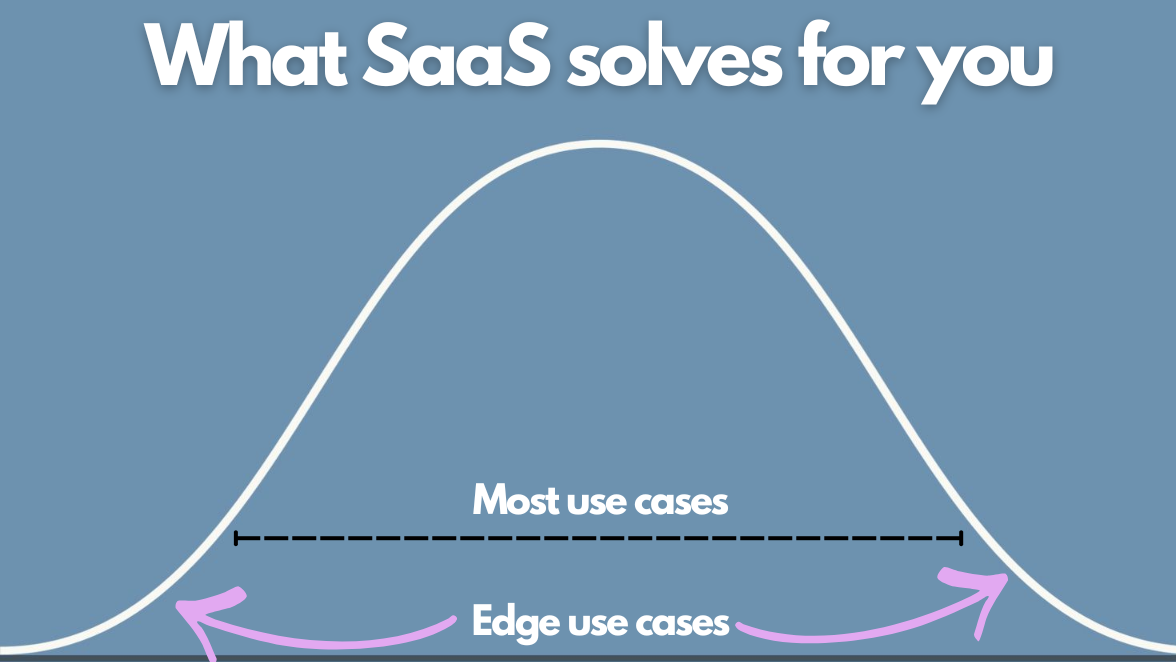
In other words, they standardize the middle of the market.
That is exactly what makes them successful. Predictability keeps support manageable, consistency keeps the product stable, and shared architecture keeps costs under control.
But the consequence is that the edges of the problem space often remain unsolved.
Those edges are where companies begin building workarounds. Over time these workarounds accumulate into what many teams quietly recognize as the shadow stack.
Small pieces of glue holding everything together.
Zapier workflows - been there
Webhook handlers - done that
Custom scripts - did it last week
Data transformations - don't get me started
...and manual steps that somehow became part of the official process.
None of these were part of the original architecture. They appeared because the platform solved most of the problem, just not all of it.
The last 20%
The uncomfortable realization for many organizations is that the missing 20% is often the most important part.
That gap frequently represents the workflows that make a company unique. The unusual lead routing logic with custom API calls that reflects how the sales team actually works. The attribution model with cookie extension scripts that better matches how the business sells. You get the picture.
These edge cases are not accidents at all. Don't be misled. They are the result of organizations adapting to their environment. Rowing with the oars you were given.
Which creates a stranglehold on progress.
SaaS platforms provide the infrastructure that makes modern marketing possible. But differentiation rarely happens in the middle of the bell curve.
It happens in the edges.
Modular stacks and the rise of micro tools
Over time, the industry has responded to this problem in two different ways: by making stacks more modular, and by building smaller tools to fill the remaining gaps.
The first response is architectural. Composable approaches aim to make Martech stacks more modular, allowing components to be connected, replaced, or extended more easily. Instead of forcing every function into a single platform, systems can communicate through APIs and shared data layers.
Composable architecture does not remove the 20% gap, but it does make the stack easier to extend when necessary.
The second response is more practical. Companies begin building small tools that solve the specific problems their platforms cannot address. These tools are rarely grand platforms of their own. More often they are focused utilities that perform one task extremely well.
You could call them internal apps, extensions, or micro-SaaS if they eventually become products. The label matters less than the reason they exist: standardized platforms stop just short of what the organization actually needs.
AI makes the edges easier to build
This is where the current wave of AI-assisted development becomes interesting.
Over the past 6-months I have spent close to 1000 hours experimenting with vibe coding, mostly on commercial initiatives. One of them is the Martech Stack Builder, an application designed to help people explore Martech architectures and vendor combinations.
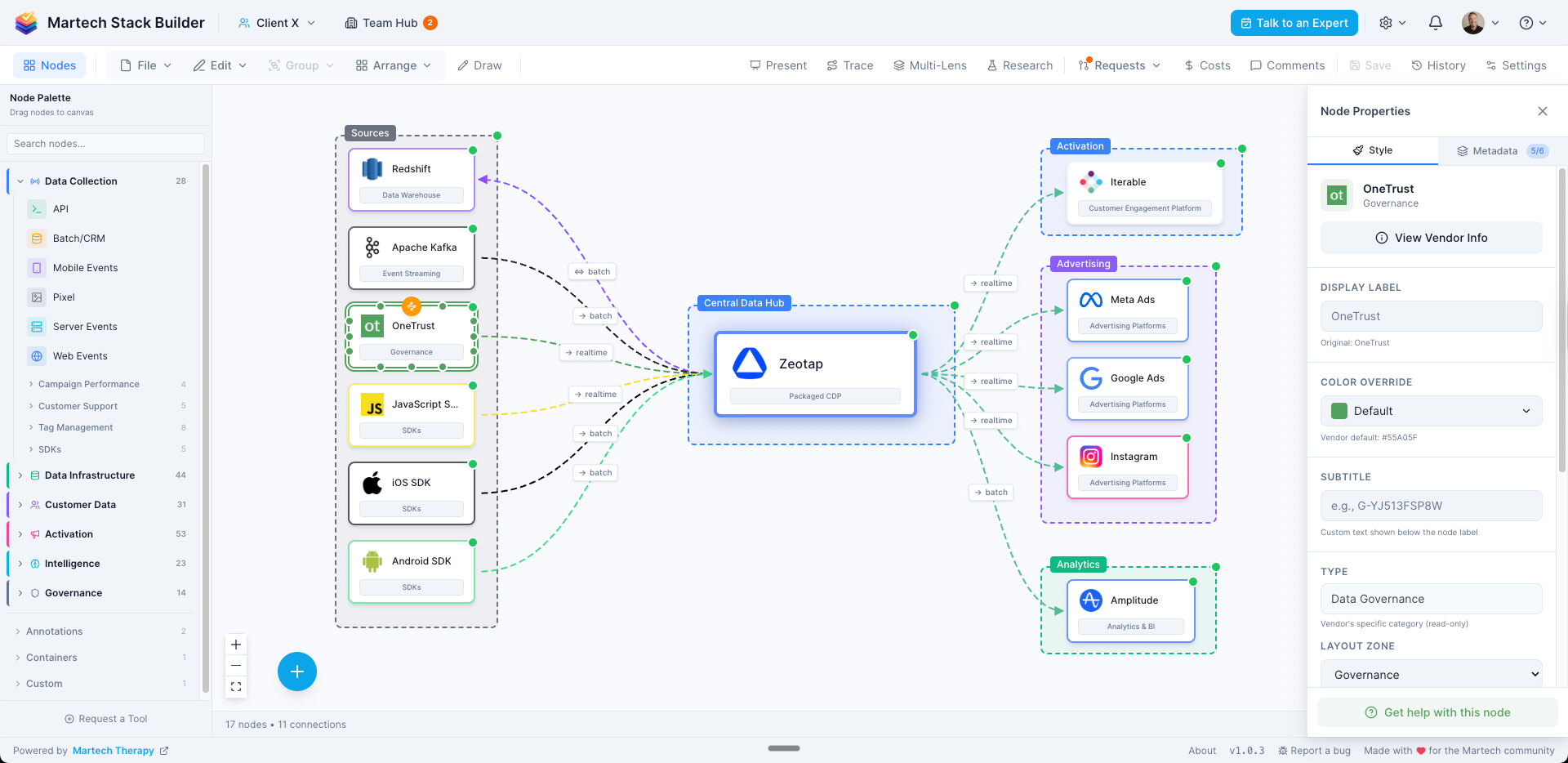
Projects like this taught me something quickly: building the missing 20% is often easier than it used to be.
But it introduces a different kind of responsibility.
In a previous article I wrote about the hidden trade-offs behind vibe coding. The short version is simple. When you build your own tools, you gain flexibility but you also inherit the operational burden.
Buying software means someone else carries that responsibility.
Building means you do.
 Matthew Niederberger
Read more about my vibe coding for Martech insights.
What AI changes is the accessibility of the edge. The strange little applications that would once have been too expensive, too niche, or too annoying to justify are becoming much more realistic to build.
The neurodiversity parallel
Listening to educators talk about neurodiverse students made that dynamic feel familiar, putting it mildly.
Many of the children discussed at the conference are highly capable. Creative, curious, and often intensely interested in specific subjects. Yet they struggle within systems designed around a narrow definition of how learning should look.
Ken Robinson summarized the problem with a different observation:
“Creativity is as important in education as literacy, and we should treat it with the same status.”
Yet many education systems still prioritize standardization over diversity of thinking. The result is a system that works very well for some students, and poorly for others.
Martech platforms sometimes behave in a similar way. They optimize for the statistical average.
But organizations rarely win by behaving like the statistical average.
Breaking the mould
Entrepreneurship often begins at the edges of these systems.
Companies like Hightouch emerged, in my opinion, because (probably 'neuro diverse') founders looked at the existing Martech landscape and realized the mould no longer fit how modern data teams worked. Warehouse-native thinking challenged assumptions about where customer data should live, while composable architectures questioned whether a single platform should control every function.
These companies did not succeed because the existing tools were bad. They succeeded because the mould had become too rigid.
Interestingly, the idea of breaking the mould even shows up in pop culture. Smash Mouth captured the sentiment rather bluntly in All Star:
“Break the mould.”
It was meant as encouragement to think differently. Apple, anyone?
And perhaps that is exactly what is happening in Martech today.
Will AI break the mould?
AI-assisted development and vibe coding are making it easier than ever to build small tools. That raises an interesting question.
Will AI break the Martech mould entirely, or will it simply make companies more efficient within the existing one?
The answer is probably somewhere in between.
AI lowers the cost of experimentation and allows teams to explore solutions that previously required significant development resources. But it does not eliminate the responsibilities that come with running software.
Systems still need to be maintained. Architectures still need to be designed thoughtfully. Operational complexity still accumulates over time. And security... I hope that that part is self explanatory.
The edges are getting easier to shape
What AI may ultimately change is not the existence of SaaS platforms. Those remain essential. CRM systems, marketing automation platforms, analytics tools, and data infrastructure benefit enormously from shared scale.
But the edges of the architecture are becoming easier to shape.
Companies can build small tools that extend their platforms instead of forcing every workflow into them. The centre of the Martech stack will likely remain standardized, while the edges become increasingly customized. Something Scott Brinker and Frans Riemersma refer to a micro-composable SaaS.
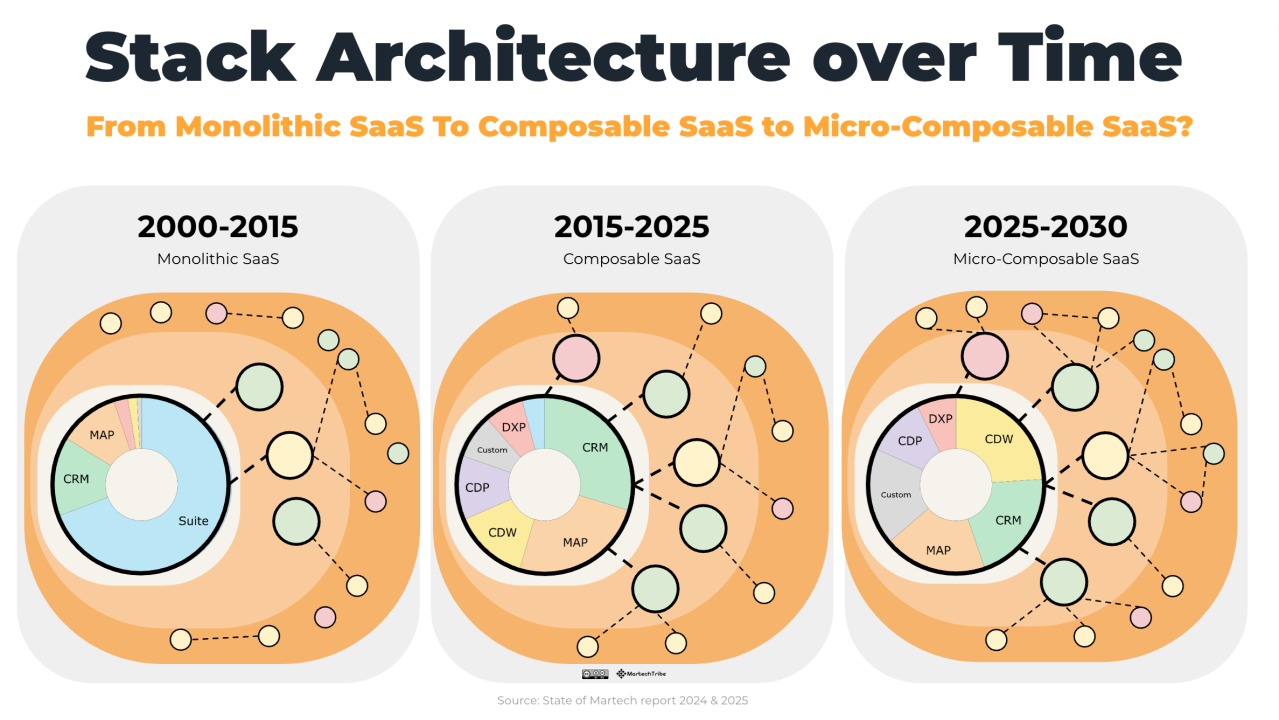
The system and the student
Back at the education conference, one idea kept resurfacing.
The goal should not be to force every student into the same mould. Instead, systems should be flexible enough to accommodate different kinds of intelligence.
Ken Robinson once described intelligence as something that is diverse, dynamic, and distinct. Systems that recognize that diversity tend to unlock creativity, while systems that ignore it tend to suppress it.
Martech may be approaching a similar moment.
SaaS will continue to dominate the middle of the market. But the companies that innovate most successfully are often the ones operating at the edges.
The ones willing to question the mould.
And sometimes, break it.

Start building your Martech Stack designs today 👇🏻
Discussion