


When I wrote The real Martech ROI equation, I was trying to articulate a frustration I kept hearing, and feeling myself. On paper, the business case made sense. The tools were implemented. The dashboards existed. The licenses were paid. And yet, the return felt harder to realise year after year.
Not because the technology stopped working, but because everything around it seemed to require more effort.
That article stayed with me longer than I expected. Especially one unanswered question: if the investment is already sunk, why does value still feel like it’s slowly leaking away?
The answer I kept circling back to wasn’t financial. It was operational. And, oddly enough, thermodynamic.
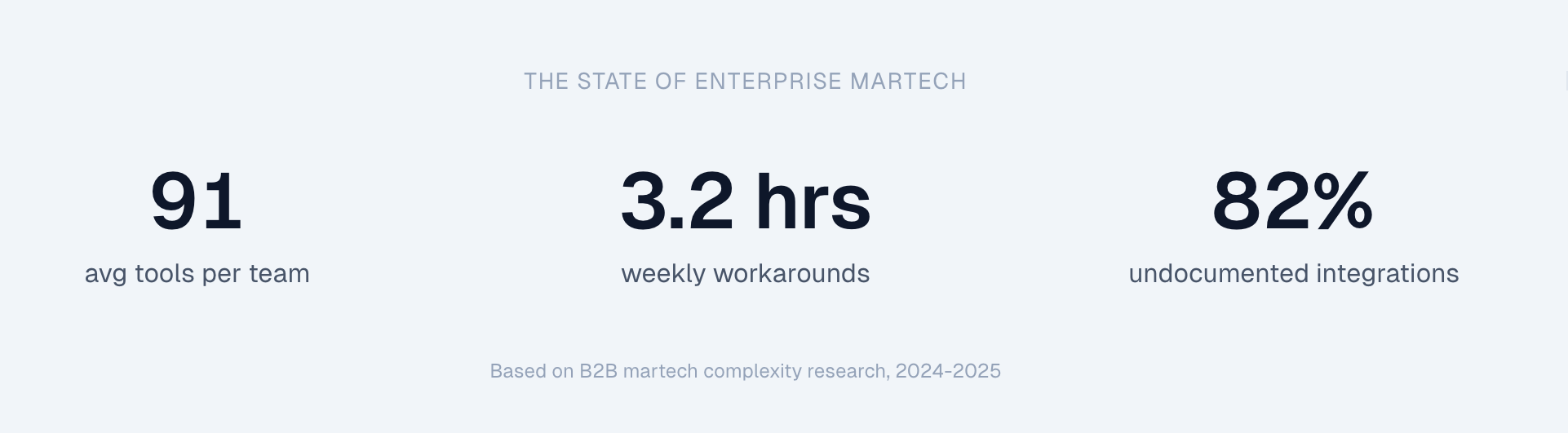
From growth to decay
For years, Scott Brinker’s Martec’s Law (yes, without an ‘h’) has been one of the clearest explanations for what we see in practice. Marketing technology tools grow faster than organisations can absorb them. It explains the explosion of platforms, vendors, and overlapping capabilities better than almost any other idea in our field.
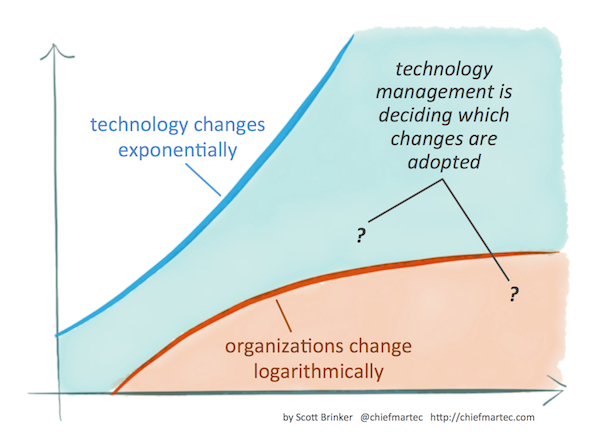
I’ve always seen that law as descriptive, not judgmental. It doesn’t blame teams or vendors. It simply states a reality.
But it also stops at growth.
It explains why stacks expand, not what happens after they do.
I spoke with Scott about this idea, and what struck me was how naturally it clicked. Not as a contradiction, but as a continuation. If growth is inevitable, the next question becomes unavoidable:
What does growth do to the system over time?
That’s where The Second Law of Martech comes in.
An Interstellar detour
Around the same time, I rewatched Interstellar. There’s a moment just before Cooper drops into Gargantua, the black hole, where he reflects on the idea that to move forward, something always has to be left behind.

It’s a line that sounds philosophical, but it’s grounded in something very concrete. Entropy. The idea that order doesn’t sustain itself. That progress is never free. That energy must be spent somewhere to maintain structure.
That scene pulled an old thread loose for me (not because of the father/daughter storyline that has me ballin’ every time I watch it). Because Martech stacks behave in a remarkably similar way.
They don’t collapse overnight. They don’t suddenly stop delivering. Instead, they ask for more. More attention. More coordination. More explanation. More exceptions. More organisational effort, just to get the same outcomes they once produced with far less friction.
What entropy looks like in real stacks
In practice, this rarely shows up as a single failure. It shows up as accumulation.
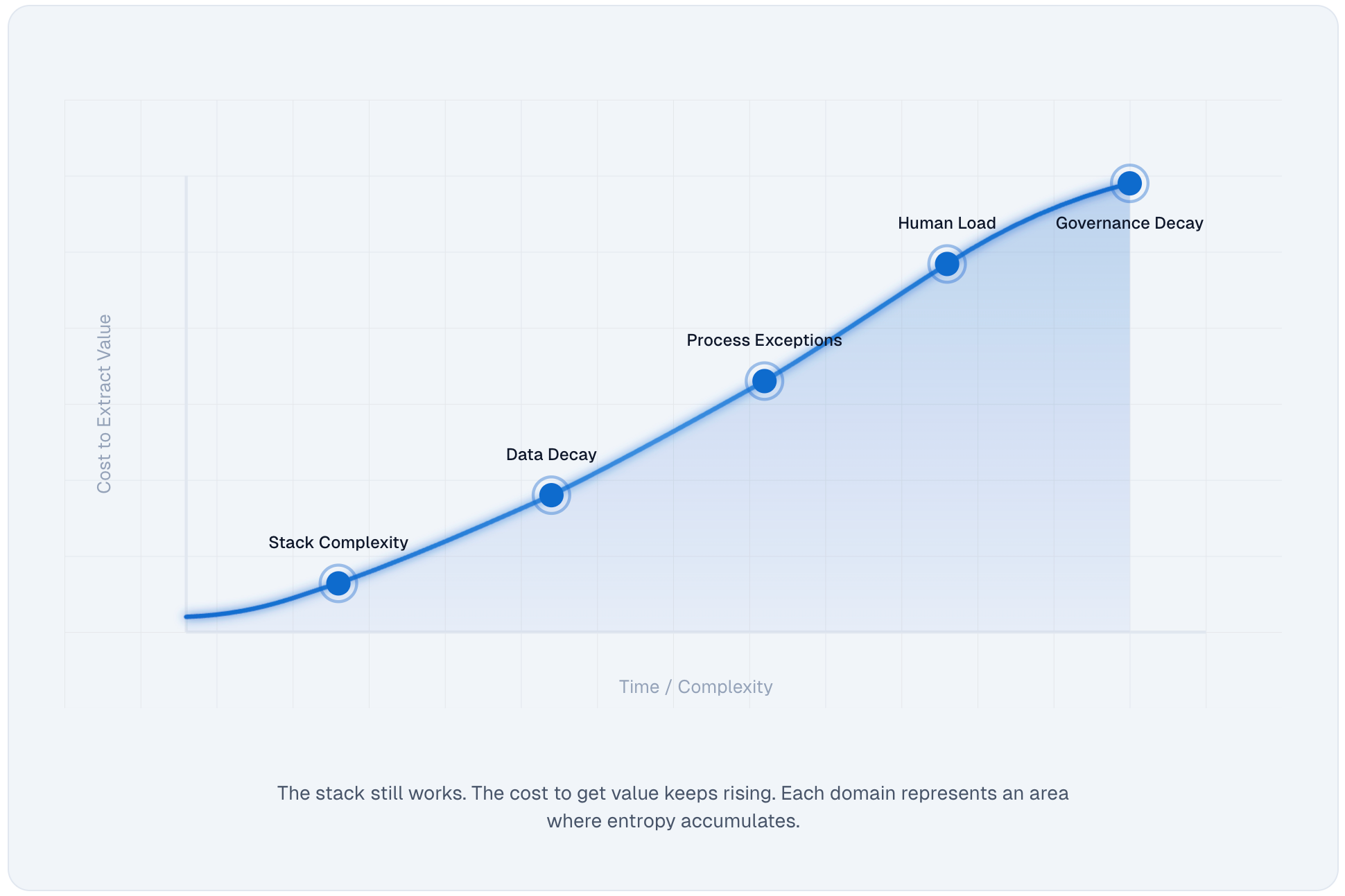
Campaigns take longer to launch, even though the tooling is more powerful. Data conversations start with caveats instead of confidence. A small group of people becomes essential, not because they are bottlenecks by choice, but because they are holding the system together through experience and memory.
Nothing is broken.
Everything still works.
But the cost of making it work keeps rising.
That rising cost is what I mean when I talk about entropy in Martech.
And it’s also where I started using a shorthand I kept coming back to: Human Energy.
Reframing Human Energy
When people hear “human energy”, it can sound abstract, or worse, motivational. That’s not what I mean.
Human energy, in this context, is sustained organisational effort. Very specific forms of it.
First, there is cognitive effort. The mental load required to remember how things really work. Which definition applies where. Which dashboard to trust. Which exception is currently in play.
Second, there is coordination effort. The meetings, handoffs, Slack threads, clarifications, and escalations needed to make systems cooperate across teams and tools.
Third, there is maintenance effort. The invisible work of fixing, reconciling, documenting, compensating, and quietly preventing drift from becoming visible failure.
Early in a stack’s life, this effort is barely noticeable. Over time, as tools multiply and processes accrete exceptions, more of that energy shifts away from creating value and toward simply preserving alignment.
Nothing dramatic happens. But standing still becomes expensive.
The Second Law of Martech
The Second Law of Martech states that
"Marketing technology systems naturally decay unless continuous organisational effort is applied to preserve meaning, flow, and trust."
This isn’t an argument against growth. And it’s not a critique of ambition. It’s a reminder that order has a cost, and that cost is paid by people, not platforms.
Tools depreciate financially. Martech stacks depreciate operationally.
Why I turned this into a framework
I didn’t want this to stay theoretical. Writing about entropy is one thing. Helping teams recognise it in their own context is another.
That’s why I built the Second Law of Martech scan as a framework. Not as a maturity model, and not as a diagnostic that tells you what to buy or rebuild. It’s meant to act as a mirror.
The goal isn’t to label a stack as good or bad. It’s to make visible where organisational effort is being spent just to keep things working, and where that effort is starting to crowd out actual value creation.
Once you can see that, better decisions tend to follow. Sometimes that means reducing entropy. Sometimes it means accepting it consciously and adjusting expectations. Both are valid. Ignoring it rarely is.
Entropy isn’t the enemy. Pretending it isn’t there usually is.
Your stack isn’t failing.
It’s absorbing more effort than it used to.
The Second Law of Martech scan helps you see where organisational energy is being spent just to keep things working, and where that cost is starting to crowd out real value.
Discussion