
What started as a side exercise, mostly curiosity-driven, has quietly turned into a real line of business. Today, roughly twenty percent of my revenue comes from building small, focused Martech tools. Not prototypes. Not demos. Actual, deployed, and maintained software.
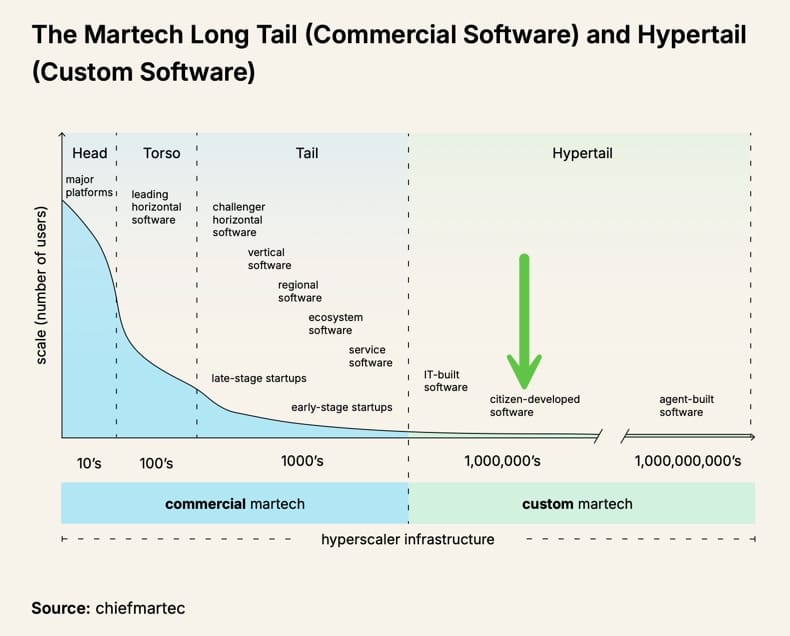
That alone would have surprised me a year ago, even when Chiefmartec's Scott Brinker and Frans Riemersma shared their Hypertail 'micro SaaS' vision in their State of Martech 2025 report.
When CDP work runs into reality
About nine months ago, a client approached me for something familiar: help selecting and setting up a Customer Data Platform. This is still the core of my work, and where most engagements begin. In this case, though, it became clear very quickly that none of the off-the-shelf solutions really fit.
 Matthew Niederberger
The client operated in a niche context, with constraints around data, verification, geography, and user effort that standard CDP workflows simply weren’t designed for. You could force a platform to comply, add layers, accept friction, and call it “enterprise-grade”. Or you could step back and question whether the problem was being solved at the right level.
After many conversations, trials with off the shelf solutions, we chose the second path.
Building the workflow, not the product
Instead of selecting a platform and bending the process to match it, we designed the process first and built around that. A series of tightly connected workflows replaced what had previously been manual, slow, and frustrating.
User input, document evaluation, location and travel-time validation, and additional checks were combined into a single flow. What used to take users twenty to thirty minutes, and often required follow-up, now completes in under thirty seconds.

Speed, on its own, is not the achievement. Respecting people’s time is.
The one thing that was really nice was the client’s reaction when they saw this working outside office hours. Not because it was clever, but because it felt dependable.
Seeing systems changes the conversation
One thing I’ve learned over years of analytics and Martech work is that understanding improves dramatically once people can see what’s happening. Visualization turns complexity into something discussable.
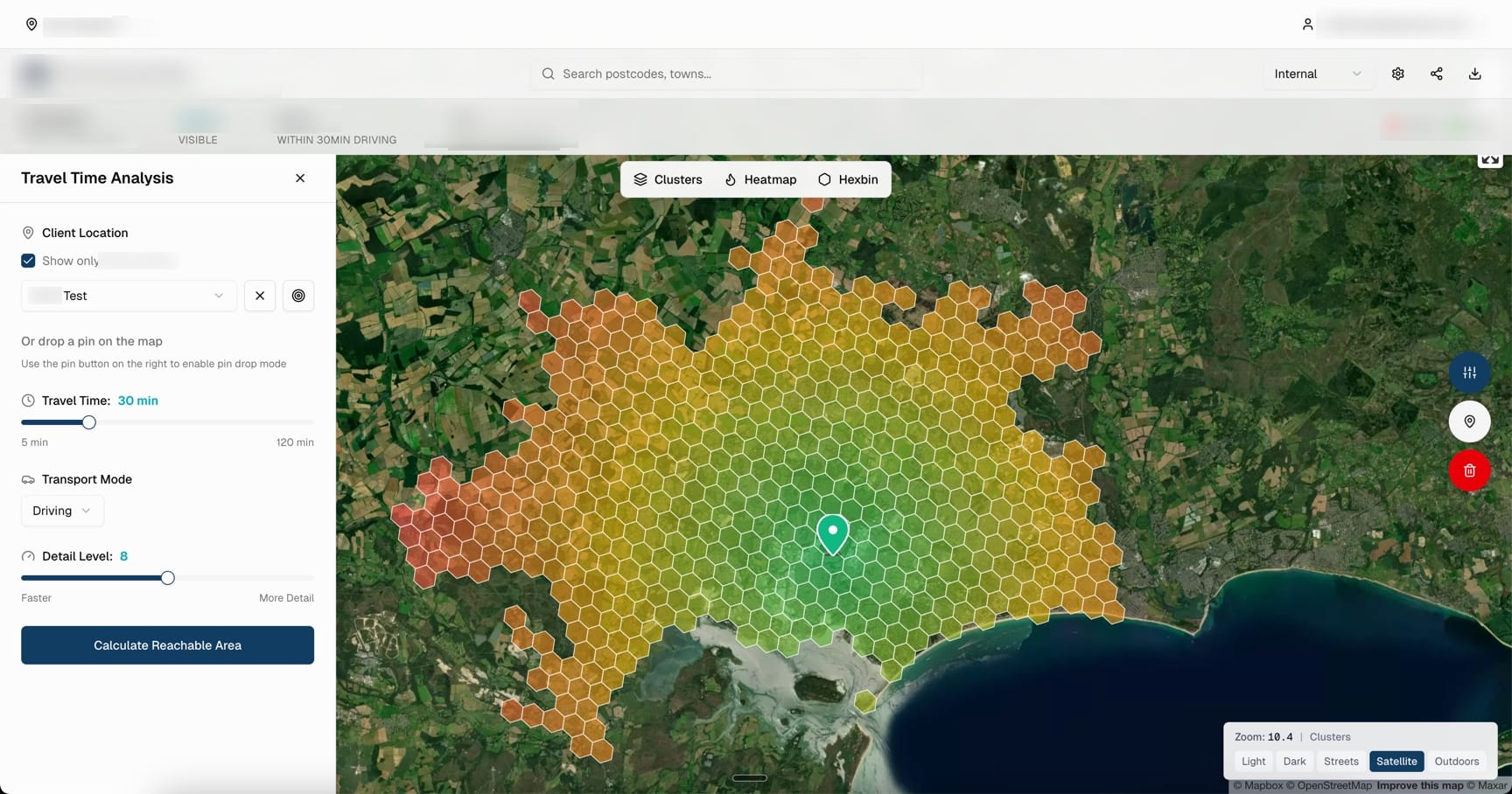
For this client, that meant visualizing user locations, obtained with explicit consent, across their base country. Distances to key locations were calculated and clustered, revealing patterns that were invisible in spreadsheets and tables. Conversations shifted from opinion to evidence almost immediately.
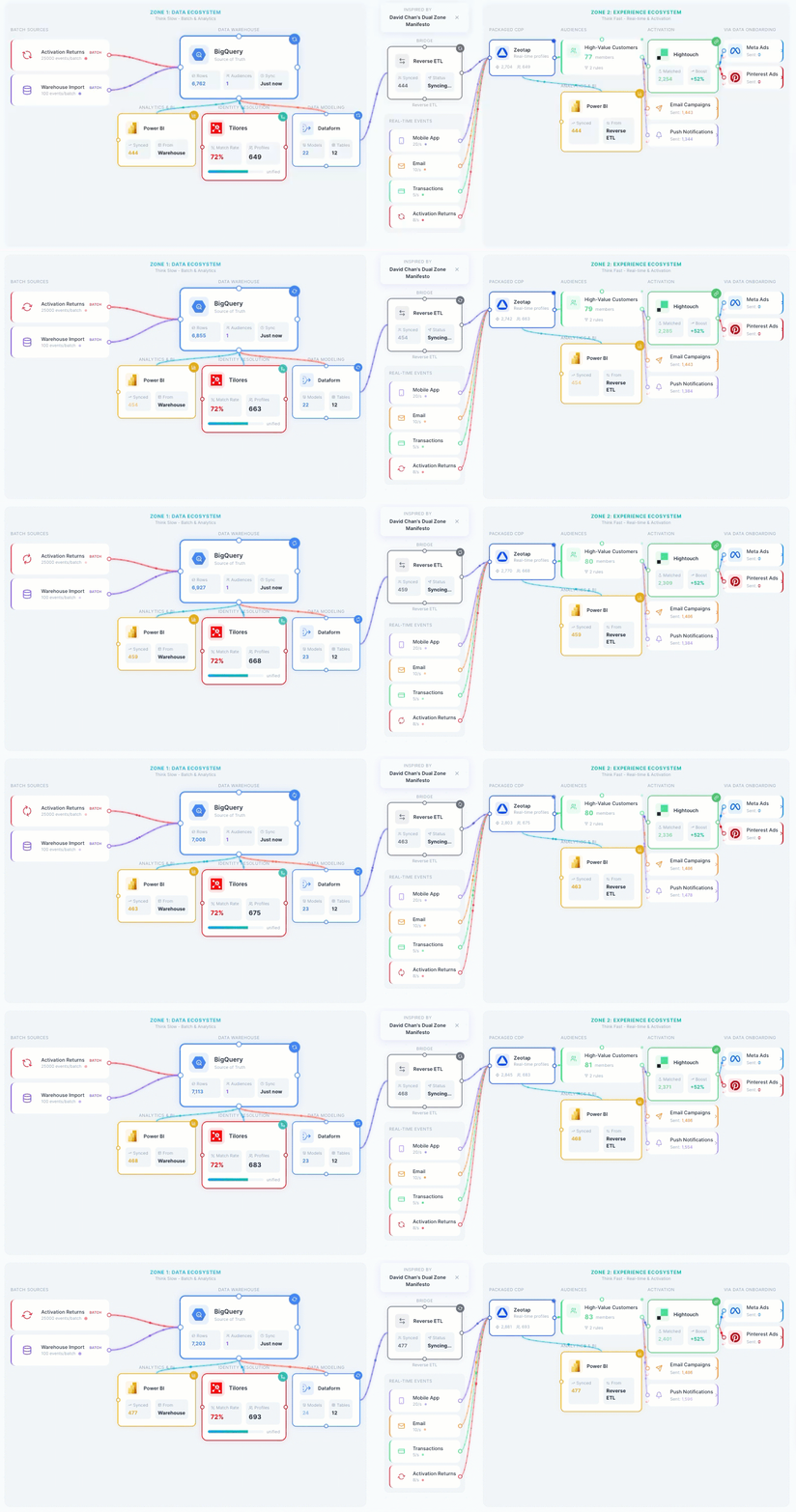
This instinct to make systems visible is also what led me to build free Martech tools like the CDP Simulator and Stack Builder. Not to explain technology, but to make decisions less abstract.
Trust me, this is not AI slop
It’s fashionable to dismiss work like this as AI slop or brain rot. I don’t recognize that critique when I look at what I and some others ship.
Every workflow went through QA. Every integration was reviewed. Access control, hosting configuration, and data handling were treated as first-order concerns. Like any serious analytics project, behavior was tracked, assumptions were tested, and edge cases were revisited.
Of course AI accelerated the work, but it did not remove responsibility.
What I won’t delegate to AI
There are things I deliberately do not hand over to AI.
I don’t let it decide what data should exist. I don’t let it define trust boundaries. I don’t let it choose hosting defaults, access models, or retention rules. And I don’t accept output without review, especially when people, locations, or decisions are involved.
AI is excellent at helping me reason faster, explore alternatives, and cross-check my thinking, there is no doubt about that. If I approach this work professionally, judgment still sits firmly on my side of the keyboard.
 Matthew Niederberger
Can anyone do this now?
This is usually the question underneath the client reactions. And the jury is still out on that one.
It's true, AI lowers the barrier to building, but it doesn’t eliminate the need for experience. Understanding how data flows, how governance fails in practice, and where systems tend to break still matters. Generalist knowledge helps enormously here. Not expert-level depth in everything, but enough literacy to know what to question, what to verify, and when to slow down.
AI helps you improve that literacy, but it certainly doesn’t replace it.
Micro, but not small thinking
What still surprises me is how quickly this expanded. From screening workflows to custom form and survey builders with verification logic, to fully integrated business development tooling. Twelve months ago, I wouldn’t have believed this was realistic without a full product team. A sentiment my clients echo.

Now it feels like the beginning of something more structural.
AI is making micro viable, not by removing complexity, but by making it manageable. The coordination required to do this well is real, and the risks shouldn’t be underestimated. But neither should the result.
When micro is built with discipline, care, and respect for the systems underneath, it stops feeling small. It starts feeling like a correction.
Want to learn more about how I can help your organization scale quickly and safely with AI?
Discussion