

I recently returned from my holiday without some magical Martech insight. What I did pick up was a plethora of LinkedIn posts and private messages from people who have been let go from their positions, or who are sharing their experiences of a perceived drop in Martech-related contract work.
And an announcement from my friend Daniel Heer. More about that later.
In total, a handful of conversations over the last few months, from three different parts of this industry, all describing the same thing.
I will try to tell the story, using some light-hearted references to one of my favorite movies and songs.
What are the signals...
An agency owner telling me work has slowed. Two people at vendors who were let go. Two other contractors watching the same drop in assignments I am. Different companies, different corners of the business, but still the same story.
Is this the point we say it is time to change careers and become a truck driver? Sorry, I could not hold back on that scene from Top Gun...

When people get let go in martech, a fair number end up contracting, and some of them ask me how to go about it, because I have been doing this for almost twelve years in the work they do.
I have given the same answer for years.
Get two clients before you need them. Do not undercut yourself in the first month because you will never get the position back. Keep six months of runway and stop looking at it.
Obvious disclosure. I sell days for a living, so I am not a neutral observer here.
However, lately, I am less sure about that answer than I used to be.
What I am actually seeing
Let's point out the elephant in the room first. Contract volume is down, mine included. Assignments that used to attract three or four serious bids now attract seven or eight, and half of those people were principal level somewhere twelve months ago. I have lost work to people I would have happily subcontracted. That is a new experience, and I do not like it.
I'll be honest. I have also looked at two vendor roles (product evangelism) that came past me this year, which is not something I have done in a long time. I did not take them, and I am still doing this, being independent, by choice. But I looked, and I know people who looked a good deal harder than I did.
It is uneven, and that gets lost when everyone is gloomy at once. Some geographies are still busy while others have gone flat, and the difference is bigger than anything you would guess from LinkedIn.
The same is true by type of work.
From what I have seen, more is happening in hands-on contracts than in strategy work right now, which tells you what budget holders think they can defer.
Strategy is the first thing postponed and the last thing credited.
Speaking for myself, the rates are mostly holding, and that is what fools people. If you only look at your day rate, everything looks fine right up until you notice you have billed eleven days this month.
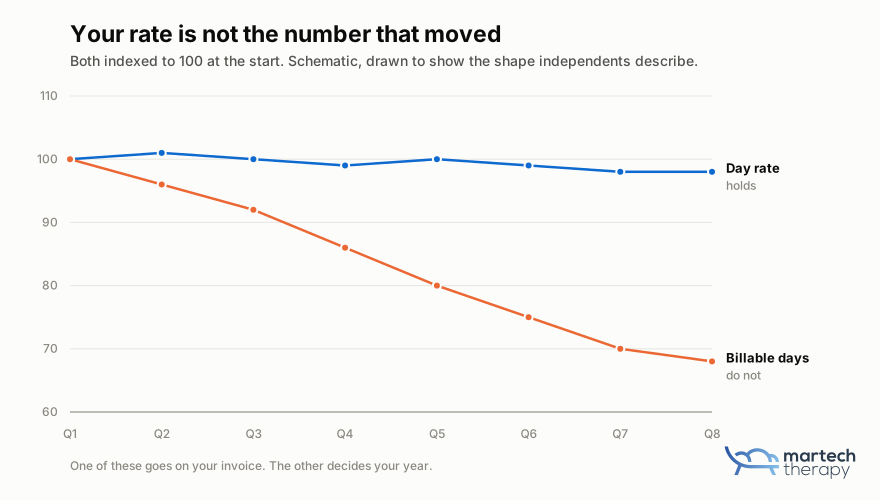
The two who were let go will probably be contracting by the autumn, and they arrive into this.
If you have done it yourself, you know how it goes. The announcement post does well. Someone you have not spoken to in years makes an introduction, and it turns into work, and your first invoice is bigger than any payslip you ever had. Then it goes quiet, and it does not feel dangerous yet. A client pauses until the new budget year. A proposal you were told was a formality goes into legal and stays there.
Everyone has it at the same time now, which means it is something else.
Why I think it is happening
Some of it is AI, though less of it than the noise suggests, and the timing is what gives it away. Bear with me as I try to explain.
Marketing budgets stopped growing well before anyone could get an agent to configure a tag. Money moved out of martech and into paid media, and the agencies got squeezed first. That was two or three years ago. AI did not start this.
What AI changed is who can do the work. A capable junior with good tooling now covers a surprising amount of what used to need someone with ten years on them. The judgment is still hard to replace. So if you are running a team, the math has changed.
You can staff more juniors, give them AI, and keep one senior person to catch what goes wrong. That is cheaper than what you were doing, and for now it mostly works, but tread carefully. I have written before about what that does to an organization chart.
Cognizant's chief executive describes this openly. They call it a broader pyramid, which means using AI to push high-value technical work down to entry level, then hiring graduates by the tens of thousands to sit at the bottom of it. It is the clearest strategy anyone in this industry has articulated, and it explains the senior squeeze far better than the general panic about robots taking jobs.
Meanwhile dentsu spent a decade buying up the martech services business and last year wrote most of it off.
Publicis added eleven thousand people over the same period. So the agency world is not suffering evenly. The damage is landing on the businesses that sold what we do.
But keep the following in mind.
From inside client work, AI is doing less than the outside noise suggests. It comes up in every conversation and drives far fewer decisions than you would think. Most of the brands I sit with are nowhere near the productivity they describe in public, because the integration is simply not there. This is closer to AI replacing processes than people.
The model is fine.
Getting it to reach the data, the consent state and the campaign tooling well enough to beat what a competent person did manually is where it stalls, and it stalls for months. So when a client tells me their headcount plan assumes an AI productivity gain, my first question is whether they have measured that gain or read about it.
Have you priced this in?
Now the skeptical part, and you should know I have an interest in being right about it. 😉
The first problem is that AI turned out to have a bill.
The assumption for the last two years was that the marginal cost of the work goes to nearly zero. That is not what companies are finding. Nvidia's own people have said the compute for their team now costs more than the team does. Uber reportedly burned through its annual AI budget early, and Microsoft's own numbers point the same way.
Some tasks are genuinely cheaper now.
Some are more expensive than the person who used to do them and nobody has noticed, because token spend sits in a different budget line than salary and nobody reconciles the two.
The second problem bothers me more.
The whole junior plus AI model rests on a senior person catching what the junior and the machine get wrong. That is the load-bearing part. And it assumes a kind of experience that does not exist yet, because nobody has ten years of practice reviewing AI output. Reviewing a junior's work is a skill built slowly, and it works because you know the shape of the mistakes juniors make. They over-engineer, they miss the edge case, they take the requirement literally. You develop an eye for it. It is the same absorption problem I described in Martec's Law, one layer up.
AI produces a different class of error.
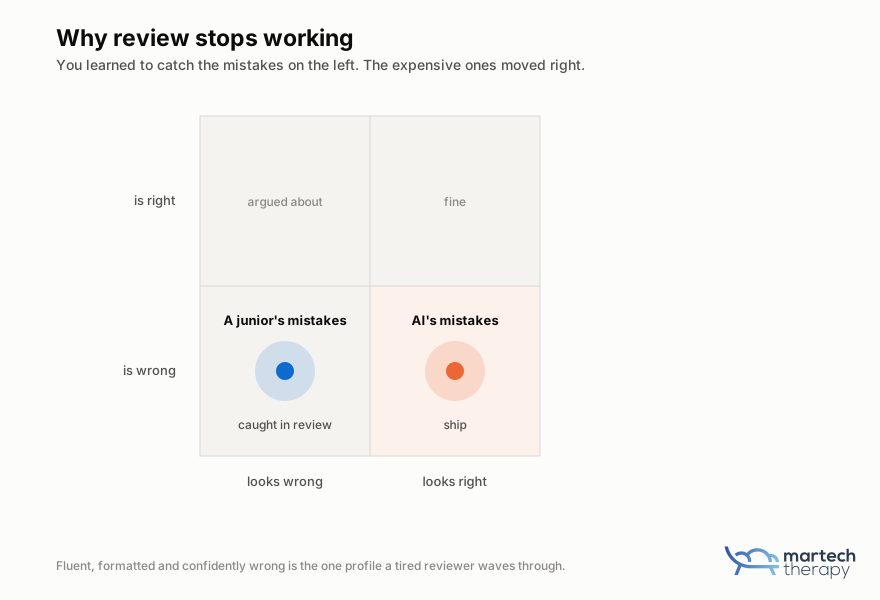
It is fluent, internally consistent, formatted correctly, and confidently wrong, and all of that reads as competence. That is exactly the profile that gets waved through a review.
Deloitte is the proof, and it is a good one, because they sell assurance for a living. They delivered a report to the Australian government containing citations to work that did not exist, and a quote attributed to a Federal Court judgment that nobody ever said. They gave part of the fee back. Their defence was that the findings were unchanged, which may well be true and does not fix anything. That is a firm with more review layers than anyone reading this has, and it went out of the door anyway.
If Deloitte cannot catch it, I am not confident that a stretched senior reviewing four juniors catches it in a campaign build.
I am obviously biased. I have twenty-plus years of scar tissue, and I am arguing that scar tissue is worth paying for. Discount it as much as you like. But the review problem is real whether or not it suits me, and I have not seen anyone put a number on it.
What that makes contracting, right now
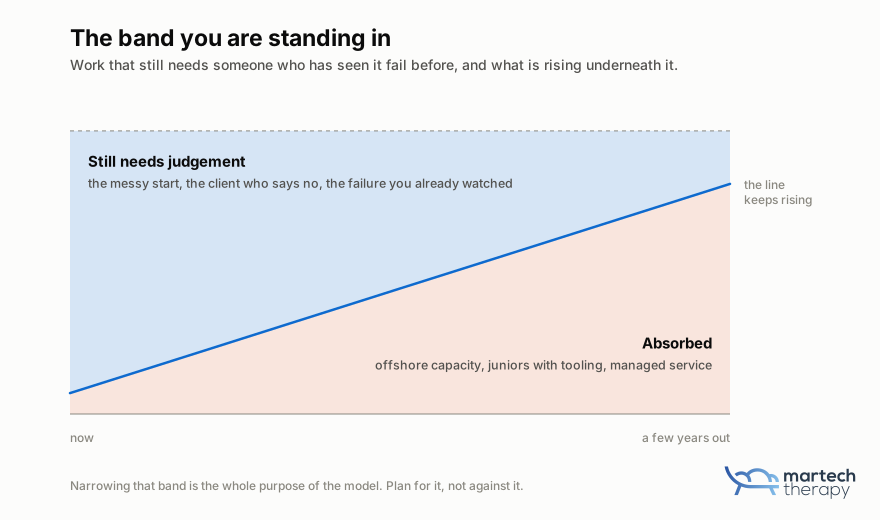
Contracting at the moment is temporary capacity while work moves somewhere cheaper. Either offshore, or to AI. Or in some cases our kids who have just finished university.
I am not complaining about it. I do this, and it pays well, and the work is often the most interesting I've seen, because what lands with an independent is whatever cannot be handed over yet. The messy first ninety days, or the client who will not accept an offshore lead on a discovery. Sometimes just the situation that needs someone who has watched it fail before.
But the list of things that cannot be handed over gets shorter every year. That is what the model is built to do.
Nobody gets offered a lateral move into the cheaper team. The cheaper team is the reason the conversation is happening at all. That is true inside a consultancy, and out here, as an independent, nobody even has to have the conversation with you.
What I would actually do
Certification is the reflex answer, and I am wary of it, although I am eyeing a few.
There are somewhere around fifteen thousand tools in this industry. Which one do you bet a month of your life on? Get certified in the wrong platform, and you have bought a badge for a market of eleven employers, none of whom are hiring this quarter.
The more useful version is regional, and nobody says this out loud because it does not scale into a nice framework. Look at what is actually being bought where you live. Demand for specific tools is far more local than the global commentary admits, and the gap between two countries in the same time zone can be enormous. Pick a couple of those and get properly findable for them instead of collecting logos. I made the case for specialization a while back and I would make it harder now. Happy to share my experiences about this, it's true.
Beyond that, the things that have reliably worked for me are unglamorous. Keep educating yourself, continuously, including on the tools you have decided you dislike. Network before you need it, because doing it after you need it is obvious to everyone. And research your own market before you trust general commentary, this article included.
Then be honest with yourself about where you sit. If you are a few years in and you landed in contracting because a role disappeared, the market you walked into is one where seven experienced people are bidding for the work you want. Going back to the brand side for a few years and building real depth will get you to the point of winning those bids faster than grinding through this market will. That is a bad thing for me to say to a potential competitor and I think it is true.
For everyone else, assume this position has a shelf life of a couple of years, and use them to become something other than a person selling hours. A product, a niche small enough that nobody staffs for it, a practice with other people in it, or a route back in-house on terms you chose. The people who came out of the last services collapse in decent shape all did some version of that.
Someone is now building a business on exactly that premise.
Daniel Heer, who spent eleven and a half years building Zeotap, has just launched The Principals Group with three co-founders, aimed at the consulting market. The line on their homepage is one I wish I had written.
Most consulting sells you seniority and delivers you juniors.
His reasoning, in his own words, is that AI will kill junior human judgement across many disciplines while senior judgement is needed more than ever, and that plenty of companies can no longer afford McKinsey and the firms like it. The gap he is building into is full of senior operators who want to leave corporate life and sell their own expertise, and who have no idea how to sell.
Daniel is a friend, and he now has a company riding on this being true, which is the same disclosure I made about myself at the top. Weigh us both accordingly.
Two things stay with me. He is putting money behind something I have only been able to describe. And they charge on outcomes rather than billable hours, which is the same conclusion I reached above, arriving from the other direction.
If senior judgement is the scarce good, the unit matters more than the rate. Hours are what a cheaper delivery model buys easily. Judgement is the part it cannot.
There is a disagreement in here we need to pause with...
Daniel and Cognizant point in opposite directions about juniors. Cognizant is hiring graduates by the tens of thousands on the basis that AI lets them handle work that used to need someone senior. Daniel is arguing that AI is exactly what strips the value out of junior judgement.
My guess is that both are describing something real, and they are describing different things. Tasks move down. Judgement moves up. Which would leave the middle of this profession with nowhere to stand, and no obvious route from one end to the other.
That is the part I would most like to be wrong about.
If you are the one buying
Now, on the flipside, there is another consideration to make.
There is an unusual amount of senior martech capability available right now at prices that will not hold.
I would be careful about treating that as good news, because every previous time this happened, brands waited. The market recovered, the same capability came back as a consultancy line item at three times the cost, and everyone agreed it was a shame.
Nobody gets promoted for hiring ahead of a recovery.
If you do want to use the window, put the senior money into review instead of build. You are already planning to run more juniors with more AI, so the constraint on that plan is not whether the work gets produced. It is whether anyone in the building can tell when it is wrong. Put your senior hire on the review layer and make the knowledge transfer a deliverable with a date on it.
That is a convenient argument for me to make. It is also what I would do from your side of the table.
What I will stand behind
Neill Brookman, a friend of mine, put it to me like this.
AI is killing everything at the moment, which is frustrating. I think it is just a short-term fad, but it will take a while for companies to realize they need experts and can't just use AI instead.
I agree with the second half of that and I am not sure about the first. Calling AI a fad is the comfortable reading, and comfortable readings have not served anyone well these past two years.
Closer to right, I think, is that the tools are real and the productivity claims are running a long way ahead of the integration. The gap between those two is where the next few years get decided.
I do not know whether this is a cycle or a reset. I have been wrong about timing on nearly everything in this industry, and I mean that as a caveat, not as modesty.
I do think the correction arrives through the review layer, not the build layer. Something expensive goes out with nobody's fingerprints on it, someone works out what it cost, and the pendulum swings back toward experience at a price that has gone up again.
Daniel is betting it arrives through the market for judgement instead. Same event, seen from two ends, and one of us is closer on the timing.
Until then, watch your billable days, not your rate. And if you are on the buying side, the cheapest thing on your desk this year is the person who has already seen it go wrong.
Now, let me send you off with some positivity...
Discussion