

Your CDP has been live for eleven months, and nobody can quite say what it's for. Two teams built against it. Neither trusts the profiles coming out. The vendor keeps scheduling quarterly adoption reviews, corporate for why isn't anyone using this.
Nobody involved was foolish. Every decision that got you here was reasonable at the time.
This is the job, most days: telling someone that something they bought for good reasons has stopped paying for itself, while the people who chose it are still at the table.
What does a Martech consultant actually do?
Depends who you ask, which is part of the problem.
What I do is narrower than most. I come in when there's a decision to make about your Martech stack and the people who have to make it are too close to it, or too invested in a previous answer, or simply don't have three uninterrupted weeks to go and find out. CDP selection. A stack that grew by acquisition and now has three places a customer record can live. An implementation that's been "nearly done" for two quarters.
I'm one person. No team behind me, no bench of juniors, no partner tier I'm steering you toward. That is a real limit and you should factor it in. It also means the person in your kickoff is the person doing the work.
Do you advise, or do you build?
Both, though not on the same day.
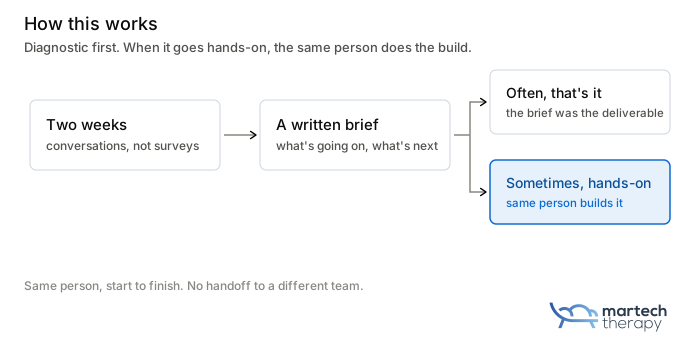
Most of it starts advisory. I look at what you have, talk to the people who use it, and come back with something you can act on. Sometimes that's a selection recommendation. Sometimes it's a note saying the tool is fine and two teams disagree about who owns the customer record, which no software will settle for you.
Where it goes hands-on, it goes properly hands-on: segment implementations, CDP configuration, identity resolution logic, the integration work that vendors describe as one click and that never is. Twenty-two years of this, most of it before there were courses to take.
How does CDP selection actually go?
Badly, usually, and for a predictable reason. The list gets built from vendor material, so every option sounds like it does everything.
So the first thing I do is take that list away and write down what the thing has to do. Not features. The four or five decisions your business makes about a customer that the system has to support. Then the list comes back and most of it falls off on its own.
If you want to see how your own list holds up before you call anyone, the Martech Stack Builder lets you map it yourself first.
 Martech Stack Builder
Pricing is where it gets uncomfortable, because the models are not comparable. CDPs mostly charge for the data you hold. Engagement platforms charge for what you send. "Usage" means something different at every vendor, and the number in the proposal is rarely the number in year two. I'll model your real volumes against their real meters (dull work, and the single thing that most reliably saves money).
Honestly, if Gartner or Forrester matter to your board, I can tell you what those reports measure and where the quadrant stops being a useful guide to your situation. I read them. I just don't treat them as a shopping list.
What does it cost, and how does that work?
Day rate or fixed scope, and I'll tell you which one I think fits before you ask.
Short diagnostic work is a fixed price, because you should know what a second opinion costs before you commit to one. Longer builds run on a day rate. I don't do retainers where the hours go unused. I'd rather scope something small first, so we both find out whether this works before anyone signs for a quarter.
Look, I'll also tell you when you don't need me. That happens more than you'd think. Call it self-interest → a bad fit costs me more in a month than the invoice was ever worth.
When is it worth calling someone in?
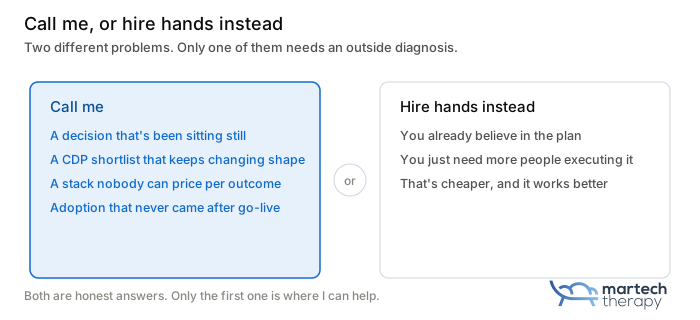
The signal is a decision that's been sitting still.
Maybe you're three months into evaluating CDPs and the list keeps changing shape. Or the stack works, but nobody can explain what it costs per outcome. Or an implementation finished, adoption never came, and the retro has been rescheduled three times now. Those are the ones where a few weeks of outside attention actually moves something.
But if what you need is more hands on a plan you already believe in, hire hands. That is cheaper and it will work better.
What happens in the first two weeks?
I talk to people. More than you'd expect, and deliberately including the ones who have to live with the system rather than the ones who chose it.
Then you get something short and written. A few pages: what I think is going on, what I'd do about it, and what I'm still unsure about. Genuinely, the things I can't answer after two weeks are usually where the real risk sits, and naming them early is cheaper than finding them in month four.
After that you decide whether there's more work, and plenty of the time there is not. The written brief was the deliverable.
Who I work with
Scale-ups that bought enterprise tooling slightly before they needed it, or rather before they had the process to run it, and enterprises where the stack has outlived the strategy that justified it. European mostly, remote by default, on site when the conversation genuinely needs a room.
I work in English and Dutch. I've got opinions about vendors and I'll share them, including about the ones I like.
So, is this you?
If you're somewhere in the middle of a Martech decision, and the middle is where you've been for a while, that's the conversation I'm useful in. Send me what you're looking at. If I'm the wrong person I'll say so, and I'll usually know someone who is.
You can reach me through the contact details on this site, or on LinkedIn, where I'm considerably more talkative 😉
Do you have any questions after reading this page?
Or need support with your Martech projects?