


A follow-up to the follow-up. My last piece explaining "what the context layers has to do" argued that customer state has to be Queryable, Addressable, Current, and Accountable if agents are going to act on it in real time. It ended pointing at a one-page audit and stopped there.
This is that audit.
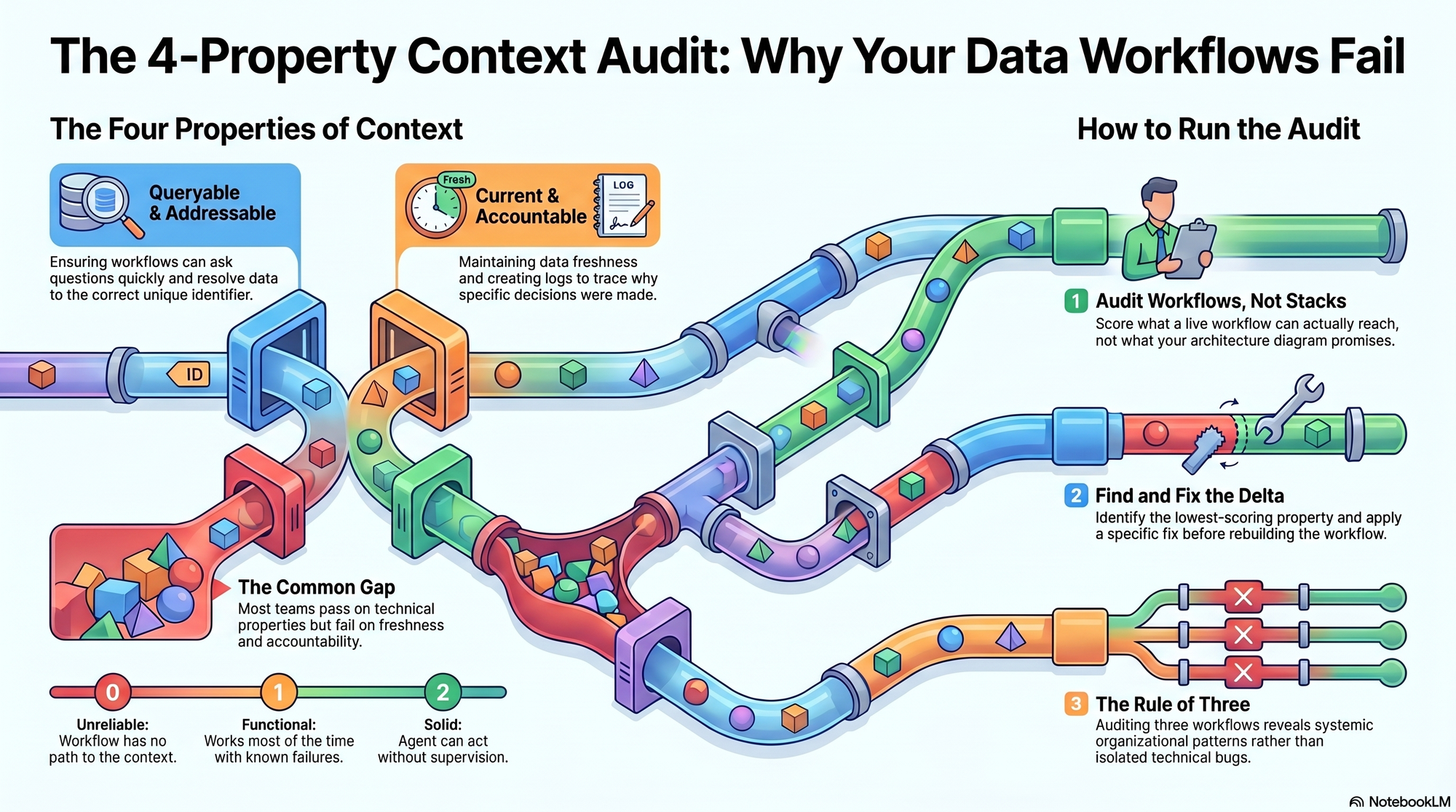
The context layer's job is to make the customer state usable when an agent needs to act on it. Whether it's doing that job is not a question anyone can answer from an architecture diagram. Architecture diagrams describe what was bought. The audit describes what a workflow can actually reach.
So the move I described was simple. Take one live workflow. Score the context it depends on against the four properties. Find the gap. Fix the lowest score first. Then do it again with two more workflows and see what pattern shows up.
That's the whole instrument. One page, four columns, three workflows.
Why audit a workflow, not a stack
A stack audit will tell you what platforms exist, what they connect to, and which licenses are up for renewal. Useful for a renewal cycle. Less useful when an agent has to decide whether to send a re-engagement email to someone who churned eleven days ago.
 Martech Stack Builder
The reason is that workflows are where context gets consumed. A platform can hold beautifully modelled customer state and still be invisible to the workflow that needs it, because the workflow reads from a different system, on a different cadence, with a different identity key. The data is there. The agent can't see it. The decision happens anyway.
So the audit starts at the workflow and works backwards. What context does this workflow need? What does it actually have? Score the delta on four properties. Done.
The four properties as a scoring rubric
Each property gets a score from zero to two. Zero means the workflow can't rely on it at all. One means it works most of the time, with known failures. Two means it's solid enough that an agent could act on it without supervision.
| Property | 0 | 1 | 2 |
|---|---|---|---|
| Queryable | Unreachable | Reachable, awkward | Documented, fast, parseable |
| Addressable | Wrong identifier | Mostly resolves | Same identifier end to end |
| Current | Stale by design | Mostly fresh enough | Window matches the decision |
| Accountable | No log | Partial log | Decision log with inputs |
Queryable is whether the workflow can ask the right question of the context, in the right shape, fast enough to act. A two looks like a documented query, a known latency, and a response format the workflow can parse without translation. A zero looks like the context exists in a warehouse table that the workflow has no path to.
Addressable is whether the context resolves to the right unit of work. A two means the workflow knows who or what it's about, with the same identifier the rest of the system uses. A zero means the context exists, but against an identifier the workflow can't match (email vs. CRM ID, anonymous vs. known, household vs. individual).
Current is whether the freshness is compatible with the decision. A two means the context was last updated within a window that makes sense for the workflow, and the workflow knows what that window is. A zero means yesterday's snapshot is being used for an in-session decision, or last quarter's model is being used to predict next week's churn.
Accountable is whether you can trace, after the fact, what context the workflow used, what it decided, and why. A two means there's a decision log that points to the inputs. A zero means the workflow ran, something happened, and nobody can reconstruct what it was looking at when it acted.
Eight points possible. Six is functional. Four is a good sign that work needs to be done to derive real value.
Walking one workflow
Let's run through an example.
Take a re-engagement email triggered by inactivity.
The agent's job:
Send a relevant message to a customer who hasn't engaged in fourteen days.
To do that well, it needs to know who the customer is (Addressable), what they last engaged with (Queryable), whether anything has happened since the trigger fired (Current), and whether the team can later see why this specific customer got this specific message (Accountable).
Now score it.
Queryable: two. The workflow can pull recent activity from the engagement table, response in under a second, in a format the orchestration agent can use. Fine.
Addressable: two. Identity stitching between the marketing platform and the warehouse is solid. The customer is the customer. Fine also.
Current: one. The engagement table is refreshed every six hours. So a customer who clicked an email ninety minutes ago could still receive a "we miss you" trigger. Most of the time this doesn't happen. Sometimes it does, and the customer notices.
Accountable: zero. The agent decides to send, sends, and logs the send. Nothing about the agent's reasoning, the context it considered, or the alternative messages it rejected is captured anywhere a human can reconstruct it later.
Final tally, five out of eight. The workflow delivers partial value. It also occasionally produces the embarrassing "we miss you" email to someone who just bought something, and nobody on the team can explain why a particular variant got chosen for a particular customer when leadership asks.
The first move is not to rebuild the workflow. The first move is to raise the lowest score. Accountable went to zero because nobody decided what a decision log should contain. Keep in mind that this is a working session, not a full fledged project. Define the minimum payload, log it from the workflow, hold the line. Accountable goes to one. Then look at Current, which is constrained by a refresh cadence. That's a data-engineering ticket. Move it to hourly, then to streaming where the cost makes sense.
The audit doesn't tell you to do all of that this quarter. It tells you which score to raise first, and what raising it requires. One step at a time, that is something to be proud of.
Three workflows is where the pattern appears
Now, let me let you in on a secret. One workflow audit tells you about that workflow. Three can reveal a pattern.
Run the same audit on an inbound lead triage that routes incoming form fills to sales, and on a paid retargeting suppression that's supposed to stop bidding on customers who already converted. Or something more appropriate to your business.
The triage workflow scores well on Queryable and Addressable, because that's what sales operations teams have been polishing for fifteen years. It often scores badly on Current, because the firmographic data it relies on was enriched at the time of first contact and never refreshed. And it scores badly on Accountable, because the routing logic is buried in a tool that nobody on the marketing side has read in two years.
The retargeting suppression scores well on Current, because ad platforms force a fast cadence. It scores badly on Addressable, because the suppression list lives against a hashed email and the conversion event lives against a customer ID, and the join between them is approximate. And it scores badly on Accountable, because nobody is keeping a log of which customers got suppressed when, so when finance asks why ad spend doesn't reconcile, the answer is a shrug.
Three workflows, three different lowest scores, but in most real-world cases a pattern starts to show. Most teams pass on Queryable and Addressable, because those are the properties vendors sold them. Most teams fail on Current and Accountable, because nobody sold them those. Like my good friend Ana Mourão recently told me:
There's no glamour in governance.
And she is right. Freshness is a data-engineering problem with no marketing budget line so it gets a low priority. Accountability is a governance problem with no owner. But we all know this, unfortunately.
That pattern is the actual finding from the audit. Not "your stack is broken." Not "you need a new platform." Something more useful: the two properties most likely to be missing are the two properties nobody is paying attention to.
Once that pattern is visible, the fix stops being a procurement question. Freshness SLAs go into the data contract. Decision logs go into the orchestration design. Both are working problems, not buying problems. There is light at the end of the tunnel.
What the audit does not do
Let's be realistic though. The audit does not tell you which vendor to buy. It scores what you have, against what workflows need. The answer might be "your current platform is fine, you just haven't connected it to the workflow that needs it."
It does not replace a data contract. It surfaces where one is missing.
It does not grade the CDP. It grades whether the context a workflow needs is reaching the workflow. The CDP might be doing its job perfectly and still scoring badly on this audit, because the workflow is reading from somewhere else.
It does not produce a maturity score. There is no "your context layer is at level three out of five." There is a list of named workflows, their scores against four properties, and a ranked list of fixes. That's the deliverable.
Run it on one workflow this week
Now, again, it is your turn.
Pick one workflow. A real one, one that runs in production, one that an agent or an automation already drives or could potentially drive. Write the workflow's name at the top of a page. Below it, four columns:
Queryable / Addressable / Current /Accountable
Score each from zero to two. Underneath, write the lowest score. Below that, write the one move that would raise it by a point.
That's the audit. One workflow, ten minutes, one page.
Do it again next week with two more, and the pattern will start to show. The pattern is the part that changes the conversation with the data team, with finance, with whoever owns the platform that nobody audits.
If running it solo is uncomfortable because the answer might be inconvenient, Martech Therapy runs context audits with teams as a half-day working session. We bring the rubric, the workflow list, and the awkward questions. You bring the workflows and the people who own them. Three audits in, the pattern is yours to act on.
Either way, the one-page version is the one that matters. The audit is small on purpose. The work that comes out of it isn't.
A follow-up to the six-part Contextual CDPs series, via What does the context layer actually have to do?
Do you have any questions after reading this article?
Or need support with your Martech projects?
Discussion