


In 2022, Hightouch published a piece with a headline built to draw attention: Friends Don't Let Friends Buy a CDP. I remember where I first saw it, neck deep in my client's packaged CDP project. Sure, it was vendor content. Everyone knew it was vendor content. Nevertheless, it got passed around, because the frustration underneath it was real, and most of us had heard it, or even felt it.
The argument was simple enough to fit on a t-shirt. Your data already lives in the warehouse. Why pay a second vendor to copy it into a separate box, call that box a Customer Data Platform, and then struggle to get your data back out again? Skip the box. Activate straight from the warehouse. The packaged CDP, in this telling, was dead weight a mature data team had already outgrown.
Almost four years on, Hightouch sells a composable CDP. Heck, even Gartner now lists them in its Magic Quadrant for Customer Data Platforms. The poacher who spent years telling you the fences were pointless now keeps the gate.
I want to be careful here, because the easy version of this story is a cheap shot, and the easy version misses what actually went on and disrespects all the effort put into the change that really took place.
What Tejas actually argued
It helps to give the original its due. Tejas Manohar, Hightouch's co-founder, was not wrong about the architecture. The warehouse really had become the place where serious organizations kept their data. Reverse ETL really could push that data into the tools where marketers worked. For an organization with engineers on hand, a warehouse already doing real work, and a tolerance for assembling its own setup, buying a packaged CDP on top of all that was paying twice for one capability. Tejas had a point. In the right room, he was simply right.
The architecture held up fine. The address on the envelope was where it went wrong.
 Matthew Niederberger
The assumption underneath
The pitch was written for data engineers. It assumed a reader who owned a warehouse, trusted the data in it, and could write the models to turn raw events into something a campaign could use. That reader is real. I have worked with that reader. But that reader is not the person who usually buys a CDP.
The person who buys a CDP is more often someone in marketing operations who needs a re-engagement campaign live by the end of the month. Their organization does not run one warehouse. It runs three, with no settled view on which is the source of truth. For them, "just activate from the warehouse" is the start of a data engineering project measured in quarters. The slogan made it sound like you were setting a toggle.
The composable argument treated warehouse maturity as the starting line. For most buyers, it was the finish line, and they hadn't reached it. That gap is the whole story, and I'll come back to it.
Exhibit A is Hightouch itself
Watch what Hightouch built. In the years since the t-shirt slogan, the product grew event collection, so it could gather the behavioural data in the first place. Identity resolution came next, to stitch those events to a person. Then audience building and campaign analytics, so marketers had somewhere to actually work. Each addition made sense on its own. Together they rebuilt, piece by piece, a composable alternative of the very thing the company had told you not to buy, the packaged CDP.
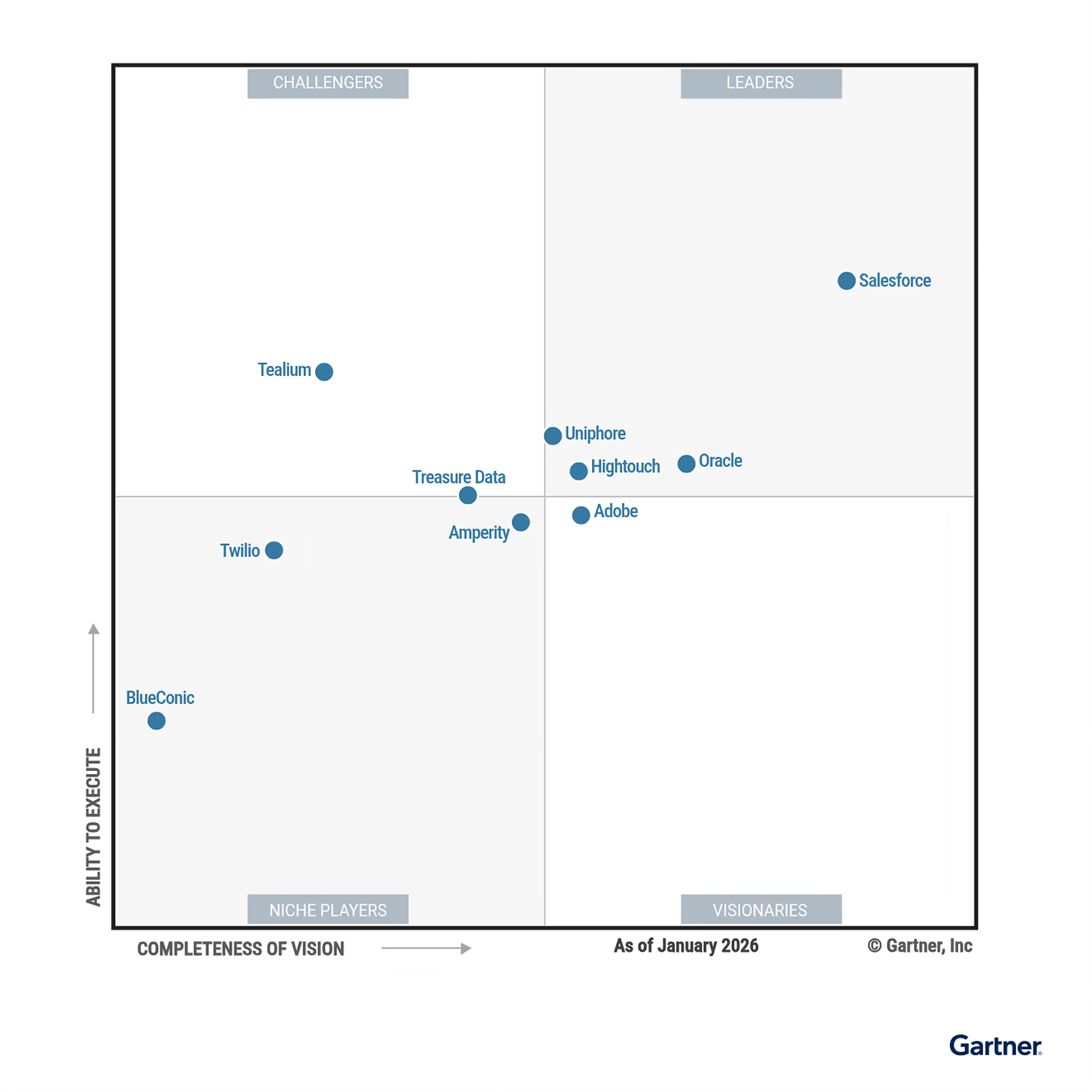
By early 2026, Hightouch had entered Gartner's Magic Quadrant for Customer Data Platforms for the first time. David Chan, who writes some of the sharpest analysis in this corner of our industry, had pointed out only a year earlier that pure-play composable vendors like Hightouch were absent from the quadrant entirely, and argued they arguably weren't CDPs at all, since they store none of your data by design. Within twelve months, the thing David noted was excluded had been included. The category redefined itself around the vendor faster than the vendor could redefine itself.
This is Hightouch delivering the architecture it argued for, and Gartner moving the category to meet it. The market kept asking Hightouch for the parts of a CDP it had dismissed, and Hightouch, sensibly, built them. The architecture won. The slogan did not last once buyers said what they actually needed.
 Matthew Niederberger
The expansion didn't stop at the quadrant either. In February 2026 Hightouch launched Content Assembly, its first content tool, and now bills itself as a composable CDP and an agentic marketing platform. It has company in that respect. In April, Treasure Data became Treasure AI, relabelling itself an "agentic experience platform." The category that spent years arguing about warehouses is sanding CDP off its own signage and stencilling "agentic" in its place.
Exhibit B is everyone else
While Hightouch was growing into the category, the leaders' tier was emptying out. Across the last two quadrants, Adobe fell from leader to visionary. Treasure Data dropped to challenger and stayed there. Tealium, a fixture at the top since the first CDP quadrant in 2024, slid to challenger as well, with Gartner pointing to a slowdown in its annual recurring revenue growth rate between 2021 and 2025. And the roster of names that simply stopped qualifying kept growing: SAP, Blueshift, ActionIQ, mParticle, and Zeta Global among them.
Calling this the death of the CDP would be tidy and wrong. An audit is the better word. Gartner's own figures are the damning part: fewer than a quarter of marketers report high usage of the CDP they bought. The vendors who couldn't prove they were worth the line item got squeezed out, and the survivors were the ones who either burrowed deeper into the enterprise data setup or rebuilt themselves toward the warehouse-native model Hightouch had been preaching. The packaged silo, sold as a finished product to a marketing team, was the thing that aged badly.
So what does composable even mean now
Here is where I plant a flag, knowing I might walk it back in a year. I am not infallible. Composable won the architecture argument. Nobody serious now claims the right answer for a large organization is to copy all its data into a proprietary box it can't see inside. Even Gartner has come around to warehouse-native as a credible, often preferable design.
But "composable won" and "you don't need a CDP" turned out to be different sentences. The model still describes a CDP. It just assumes the warehouse is already carrying the load underneath it, and that assumption is a wager. Whether it pays off depends entirely on who is making it. For an organization with a well-modelled warehouse and a data team, composable is liberation. For an organization without those things, composable is a bill for work it hasn't done yet, and often presented as if the work were already finished.
This is roughly the question David keeps circling. If a vendor stores none of your data and resolves none of your identities until you build the pipes, is it a CDP, or is it a very good activation layer waiting for you to supply the platform? The honest answer is that it depends on what you bring to it. Which is a deeply unsatisfying thing to put in a Magic Quadrant, and exactly the thing a buyer most needs to hear.
 David Chan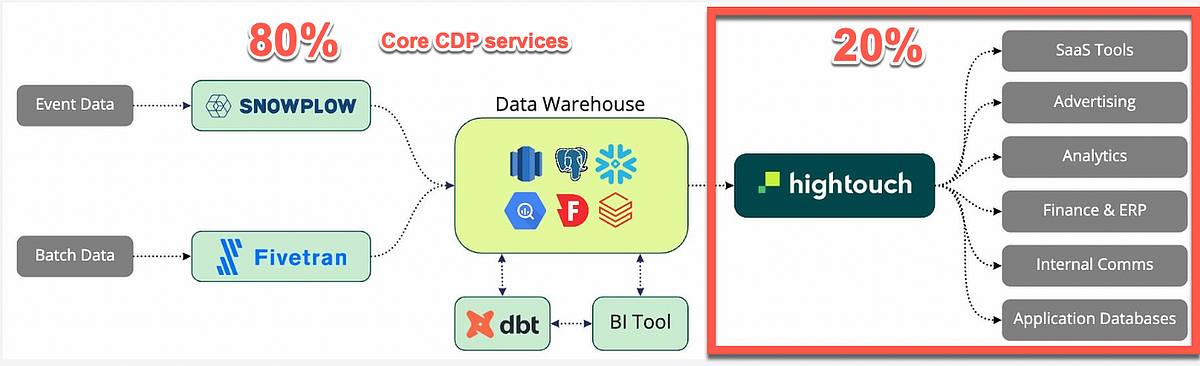
Read more by David Chan
The question that outlived the argument
The fight everyone had for five years, packaged versus composable, was an argument about the shape of the tool. Success or failure came down to something the tool never controlled: the state of the organization holding it.
I keep coming back to this in client work, and it is the spine of how I assess martech readiness: structure, capability, and process. Does the organization have the structure to own customer data across teams instead of fighting over it? Has it got the capability, the actual people and skills, to model and maintain that data? And the process to keep it clean once the launch glow fades? An organization that can answer those three can succeed with a packaged CDP, a composable one, or, as I explored in the Multi-CDP Reality series, more than one running in parallel without it being a scandal. An organization that can't answer them will struggle with any of them, and will blame the vendor either way.
The 2022 article was a good provocation. The industry needed someone to say the packaged silo had problems, loudly, and Hightouch said it louder than anyone. What the industry maybe didn't need was for buyers to take it as permission to skip the unglamorous work, buy a warehouse and a Reverse ETL tool, and assume the activation layer would assemble itself. Some organizations did exactly that, and a few of them are still untangling it.
So I'll leave it where I actually am, which is unsure about the next turn. The vendor who told you not to buy a CDP now sells one that Gartner ranks, and that journey describes the market better than any slogan did. If the category could circle all the way back to itself in three years, I wouldn't put much faith in today's consensus, warehouse-native and agentic and confident, looking any wiser when we read it back in 2029.
But the consensus is the industry's argument to have. Yours is narrower and more useful. Earlier I said the composable reader is real, and that this reader is rarely the person signing the CDP contract. So the question worth your attention is whether that reader is you. Is your organization the one composable was written for, and if it isn't yet, what would it take to get there?
Part one of two. Part two works through how to tell whether composable was written for your organization, and what to do when the answer is "not yet."
Do you have any questions after reading this article?
Or need support with your Martech projects?
Discussion