
Skip to Content

Posts tagged with Customer Data Platform

Identity Resolution: a practitioner's guide to who owns the match

Identity Resolution: a practitioner's guide to who owns the match

Identity resolution is a set of business decisions about who counts as the same person. Five approaches, and what each one costs you in ownership.

In part 4 of the Agentic CDP series I made a claim and then moved on rather quickly.

Identity resolution stops being a data-team hygiene project and becomes a precondition for anything agentic being trusted with a budget.

That deserved more than the paragraph it got, so here is the longer version.

Your agentic CDP will optimize whatever you measure
Every agentic CDP will be sold on goals-based marketing. That assumes a goal an agent can chase and a signal fast enough to learn from. Most teams have neither.
Identity Resolution: a practitioner's guide to who owns the match Read More

Right-time marketing and the speed of context decay

Right-time marketing and the speed of context decay

"Real-time" hides three different clocks. What it means from a data warehouse, why context decay is the real metric, and where five CDPs draw the line.

Every customer data vendor sells real-time. It's on the homepage, in the demo, in the answer to question fourteen of that RFP in front of your nose. The word carries a lot of weight, yet most of that weight stays out of view.

Ask what real-time actually means once the data lives in a warehouse, and that single word splits into three separate jobs that you can remember with the CDP acronym, too.

The first is collect: getting an event into the system at all. A click, a purchase, a page view, arriving through an SDK, a

Right-time marketing and the speed of context decay Read More

Did CEPs just hand the data layer to Databricks?

Did CEPs just hand the data layer to Databricks?

Three engagement platforms made the same bet in the same week. Whether it pays off is more contingent than the announcements suggest.

In 2019, I had a client running both Segment and Iterable, and the recurring question was where to build the audiences. Segment could build them. It could not act on them. Only Iterable could turn an audience into a journey, so that is where the audiences got built. Segmentation followed the system that could do something with it. Segment lost that job, and before long it was replaced by Hightouch. Sound familiar?

I think about that sequence whenever the industry decides it has finally settled where customer data belongs, because the answer never stays put.

The latest move arrived in

Did CEPs just hand the data layer to Databricks? Read More

Databricks CustomerLake: the data lakehouse is now the CDP

Databricks CustomerLake: the data lakehouse is now the CDP

Databricks launched CustomerLake, a lakehouse-native agentic CDP. What it means for composable vendors, Databricks customers, and the next data platform.

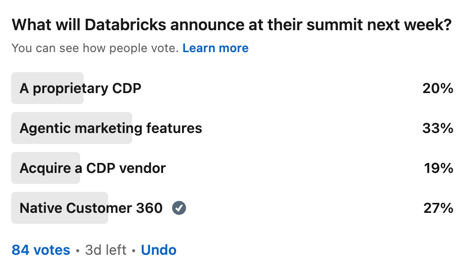
Databricks announced CustomerLake at its Data + AI Summit just now, and the rumor is confirmed: it is a customer data platform. A real one. In 2026 no less. Marketer-facing, built natively inside the lakehouse, with agents doing the work that used to need a data team and a few weeks of lead time. The first agentic CDP a lakehouse has built for itself.

Only 16 people guessed right on my LinkedIn poll.

To be fair, I saw it before the keynote. Databricks invited me to a preview and asked what I made of it, which I took as a

Databricks CustomerLake: the data lakehouse is now the CDP Read More

A little lift never hurt anyone

A little lift never hurt anyone

Hightouch, Zeotap and mParticle now sell a toggle that lifts your match rate with identifiers you never collected. The gain is real. The work is the consent check nobody does before flipping it. What it does, and what to look at first.

You spend a week defining an audience in your CDP. Lapsed high-value customers, the ones actually worth winning back. You push the segment to Meta feeling good about it. Then the matched figure comes back at around sixty percent of what you sent, and the rest just isn't there. The platform couldn't recognise four in ten of your own customers.

Anyone who has run paid media knows that feeling. It's the match rate gap, and it has a few causes. People sign up with one email and log into Meta with another. Phones get replaced every

A little lift never hurt anyone Read More

Diverted by design? What the CDP split means for the mid-market

Diverted by design? What the CDP split means for the mid-market

The CDP market didn’t just split into platforms and agents. It quietly diverted the mid-market along the way. This piece looks at what changed, why many teams now hesitate, and how CEPs became the safer path for getting things done.

In last week's part 1, I described how Gartner finally named the split inside the CDP category in their Magic Quadrant for Customer Data Platforms 2026. Platformization on one side. Agentification on the other.

Two futures, both serious, both demanding.

That still leaves a simple question hanging:

Who is this actually built for?

Because when you read this year’s Magic Quadrant carefully, the most telling signal isn’t who moved up or down, which opens another can of worms. It’s the kind of organization the category quietly assumes as the norm.

Large teams. Strong data foundations. Time

Diverted by design? What the CDP split means for the mid-market Read More