

In 2019, I had a client running both Segment and Iterable, and the recurring question was where to build the audiences. Segment could build them. It could not act on them. Only Iterable could turn an audience into a journey, so that is where the audiences got built. Segmentation followed the system that could do something with it. Segment lost that job, and before long it was replaced by Hightouch. Sound familiar?
I think about that sequence whenever the industry decides it has finally settled where customer data belongs, because the answer never stays put.
The latest move arrived in triplicate while we were distracted by what industry veteran Martin Kihn called the "CDP-related hoohaw"... CustomerLake.
Three posts showed up in my feed, probably published within hours if not minutes of each other, from Braze, Bloomreach, and Iterable, and they were all saying the same thing in nearly the same words. Each announced a tie-up with Databricks CustomerLake, the "agentic CDP" that now lives inside Databricks. Each echoed some version of the same claim:
the data belongs in the warehouse, and the engagement belongs with them.
Read one of these, and you have the gist of all three.
When three competitors converge on identical messaging in the same week, that is a coordinated launch. Databricks lined up its engagement partners so that CustomerLake would read on day one as an established category. Getting the engagement vendors to validate the CDP is how a new platform layer gets its legitimacy.
What the three actually handed over
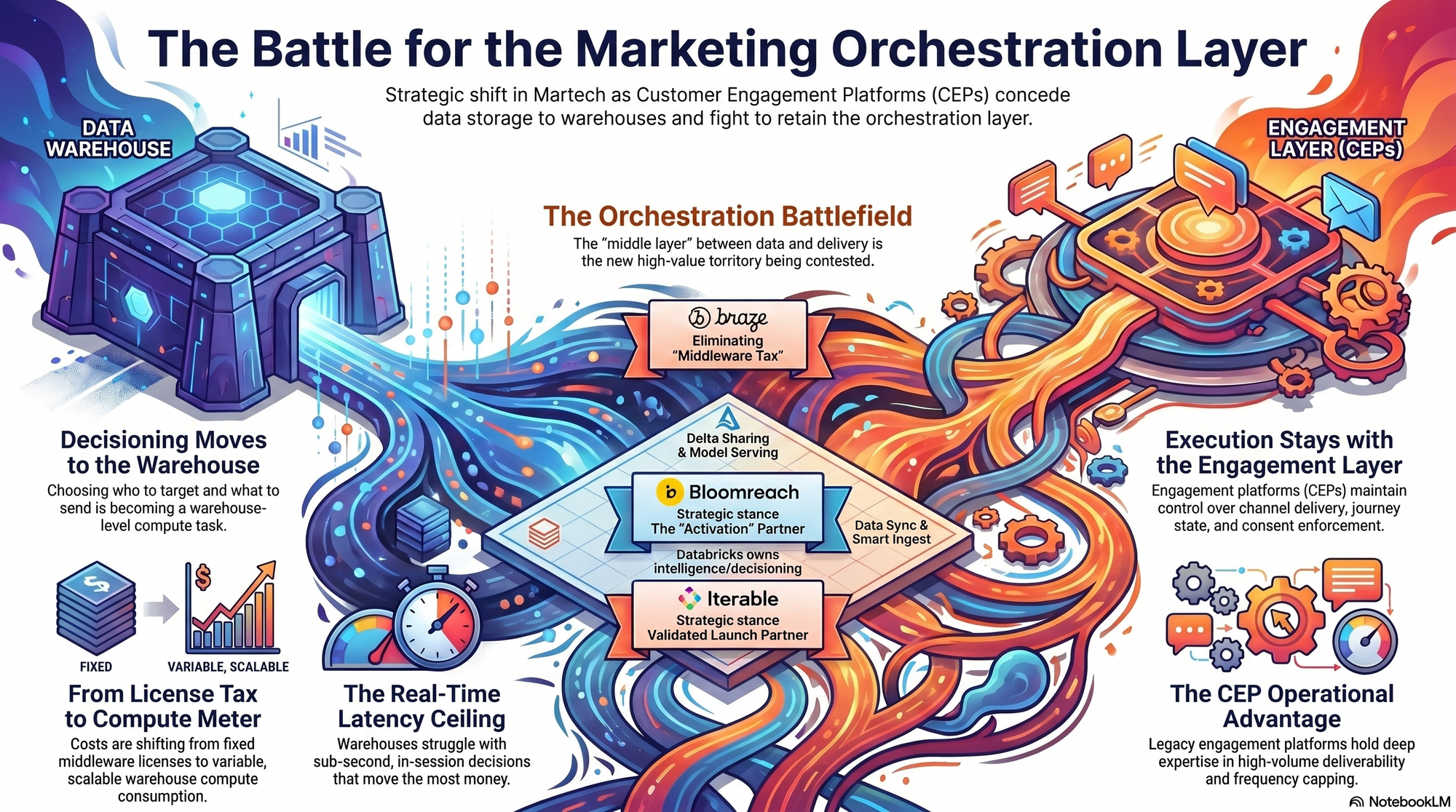
Look past the wording, and each one makes the same trade. All three concede the data layer and keep the engagement layer. Braze frames it as eliminating the "middleware tax", with Delta Sharing for write-back, Databricks Model Serving inside its Agent Console, and CustomerLake pushing governed audiences in for segmentation. Bloomreach positions itself as an activation partner and is blunt about where the line falls:
Databricks owns the data, intelligence, and decisioning, and Loomi owns activation.
Iterable comes in as a Validated Partner and launch partner through its Data Sync and Smart Ingest, citing more than 130 joint customers as proof the integration already runs at scale.
Bloomreach states plainly what the other two only imply. In its own framing, Databricks owns the customer intelligence and decisioning layer, and Loomi owns the activation layer. That is a remarkable sentence for a company that spent years selling itself as the place your customer data lives.
Why none of this should surprise anyone
For the large enterprise, the data already lives in the warehouse. Once that is true, asking a customer to copy it into a separate CDP just to run segmentation is a cost they can no longer defend. The gravity was always going to pull this way. I worked through the early version of this in my reaction to the CustomerLake announcement, and it runs straight through the Multi-CDP Reality series and the composable-versus-packaged thread before that. Same data-gravity argument, now arriving at the engagement vendors' door instead of the CDP vendors'.
So the three are conceding the layer they were going to lose anyway, and committing to the one they think they can hold. As strategy goes, that is sound. The part worth examining is the story being told around it.
Decisioning and execution are different jobs
The announcements blur two things that need to stay separate.
- Decisioning is choosing who to target, what to send them, and when.
- Execution is the orchestration that follows: sequencing across channels, holding journey state, enforcing consent and frequency, getting the message delivered.
The three CEPs are handing decisioning to the warehouse and keeping execution.
Once you draw that line, the real contest comes into focus, and it is not Bloomreach against Braze. That comparison is the sideshow the press releases want you to watch, a distraction if you will. The actual fight is the CEPs against the warehouses, both reaching toward the orchestration layer in the middle from opposite ends. The warehouse is pushing up from decisioning. The CEPs are holding execution and hoping it is enough once the warehouse decides everything upstream. Whoever ends up owning that middle owns the category. Most of the coverage I have read treats the whole thing as a data-integration story, which misses where the value is going to be contested.
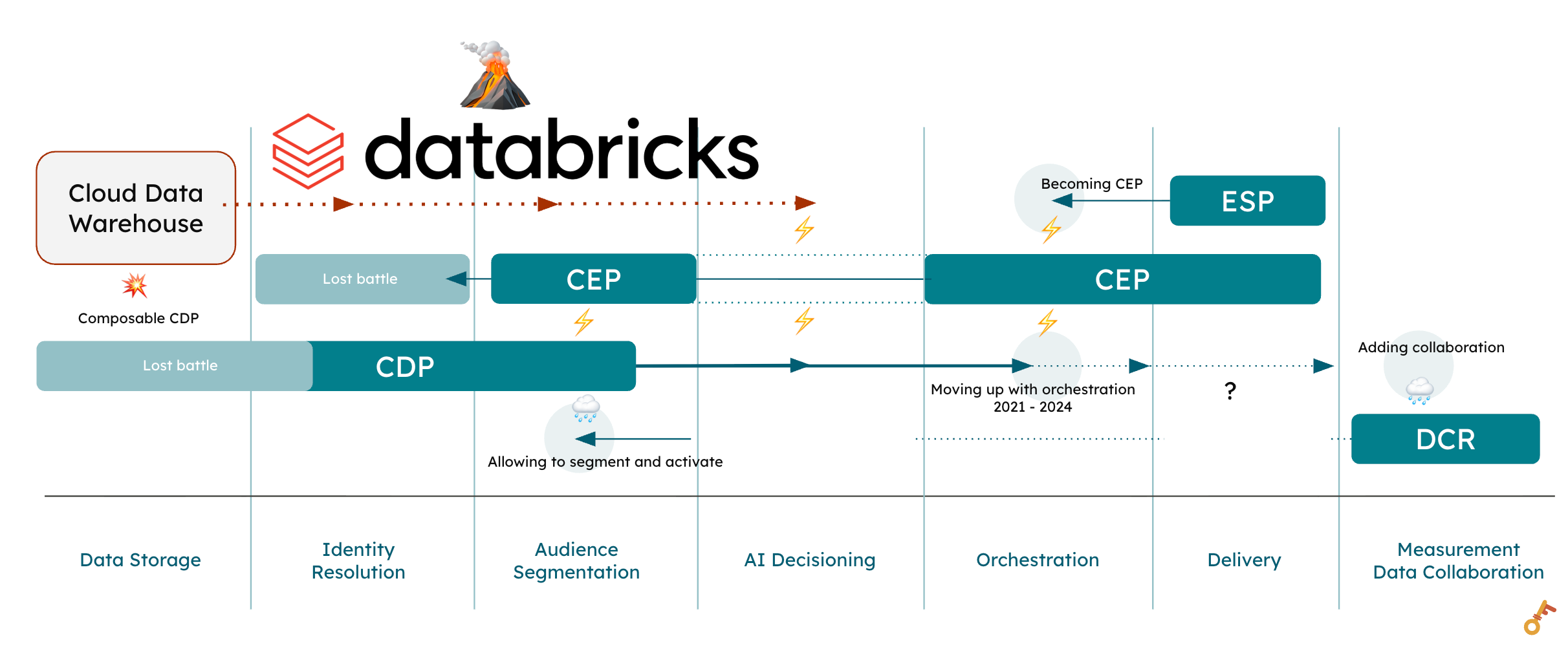
Florian Delval drew this more clearly than I can ever describe it. In his Foreign Key piece on the launch, Florian maps the martech stack as a battlefield:
CDPs that lost the data-storage fight and pushed right into orchestration, CEPs marching left into CDP territory, and a warehouse that never had to move because the workloads kept arriving on their own.
CustomerLake, from this perspective, is the warehouse finally drawing its own arrow into the middle. The distinction I would add is the one above: the warehouse is reaching for decisioning, and execution is the part it cannot easily take.
The tax moves to the meter
Braze is right that standalone CDPs and reverse ETL tools take a real hit here, maybe even a fatal one. Those categories were built to move data between systems that now sit in the same place, so their reason for existing thins out. Where Braze's framing gets generous is the implication that the cost itself goes away.
It does not. It changes shape and moves to the meter. Every audience built, every model served, every write-back stream becomes billable Databricks consumption. The middleware tax was roughly fixed, tied to licences and seats. The compute tax scales with how ambitious the marketing gets. The more sophisticated your segmentation, the more your decisioning runs, the higher the bill climbs. To be clear "eliminating the tax" and "renaming the tax as usage" are two different claims, and only one of them is true.
 Matthew Niederberger
When, or whether at all
The inevitability story skips the most useful question, which is when, and for whom. The honest answer splits by layer and by segment rather than landing on one verdict.
Warehouse-native activation for a mature enterprise is a question of when, and the answer is soon. No argument there. If the data already lives in Databricks and the engagement vendor can read from it without a copy, that path wins on cost alone.
Warehouse-native decisioning replacing the specialists is a different matter, and it is slower than the launches imply. There is a structural reason, not only a maturity one. The decisions that move the most money happen in-session, in milliseconds, while a customer is on the page or in the app. The warehouse is the system of record. It is not the live tier, even with Lakebase/RT. It does not hold the in-session signal, and it cannot answer in the window a channel actually needs. This is why Bloomreach keeps pointing at its in-memory profiles updated in milliseconds, and why Braze keeps repeating the word real-time. The slow, governed decisions can migrate to the warehouse. The fast ones are a much harder problem, and the announcements wave past it.
None of this means the execution layer is safe by default. MessageGears has run customer journeys inside the warehouse for years, and it used the CustomerLake moment to relaunch its journey builder as warehouse-native orchestration, the clearest attempt yet to pull execution into the warehouse rather than leave it to the engagement vendors. What is telling is where MessageGears draws its own line. It keeps warehouse-native journeys for the data-rich work, and routes anything that needs sub-second latency to a separate cloud tier. The vendor most committed to running execution in the warehouse still keeps a path outside it for the fast lane, which is the latency ceiling conceded by the side that would most like it gone.
Then there is everyone else, which is most of the market. Not every company runs on Databricks, and most do not have a warehouse they would trust as a single source of truth. The whole pitch assumes a level of data maturity that is genuinely rare.
This is where my Martech Readiness argument creeps into the discussion. The warehouse-native future presumes structure, capability, and process maturity that most organizations simply have not built yet. For the mid-market and below, the packaged engagement platform with its own data layer stays the practical choice for years. Architectural purity has nothing to do with it. The packaged platform works without a warehouse you have to trust first, and for most companies that trust has not been earned yet.
Why warehouse competition helps the engagement vendors
Snowflake and Google are not going to let Databricks own the agentic-CDP story unanswered, so they will ship their own versions. The counter-intuitive part is that the more warehouses compete, the more valuable a layer spanning all of them becomes. If one warehouse dominated, the CEPs would be in trouble, reduced to a feature inside someone else's platform. With several competing, somebody has to sit across them and give the marketer one place to orchestrate regardless of which warehouse holds the data. That cross-warehouse approach is the engagement vendors' route back to relevance, and it only vanishes in a single-warehouse world we are not heading into.
The competitive view cuts two ways
Against the next wave of engagement platforms that will announce the identical partnership a quarter or two from now, like Adobe and Klaviyo among them, the lead the first movers have is real but shallow. They get the badge, the co-marketing, the early reference logos like Iterable's 130 joint accounts. None of that is hard to copy. Call it two quarters before the move becomes expected rather than notable.
Against the vendors that were composable from day one, Hightouch, DinMo and Census (now Fivetran) and that crowd, the CEPs look architecturally weaker than they are. The composable natives were built assuming the warehouse is the source of truth. They carry no legacy data platform to protect. The three CEPs are retrofitting that worldview while still selling a data platform they now have to partly walk back.
The CEPs hold one real advantage, and none of them are marketing it. The composable natives came up from data movement, which leaves them thin on operational engagement depth. Deliverability at high volume, consent enforcement, frequency capping, channel breadth, the unglamorous reliability work that decides whether a hundred million messages a day actually land. That depth is exactly what the CEPs are falling back into, and it takes years to build. So the engagement vendors do hold a real lead over the day-one composable crowd, on the operational axis none of them are putting in the headline. Every one of these three posts leads with the warehouse integration, which is the part about to commoditize, and buries the operational strength, which is the part that defends them.
Where this leaves us
The collision point is that activation layer in the middle, with the composable natives climbing toward it from data movement and the CEPs falling back into it from engagement. Whoever owns that middle in three years takes the category. I think operational depth is harder to replicate than architectural purity, which would favour the engagement vendors. I also think that advantage only holds if they stop conceding the decisioning fast enough to keep a reason to sit above the warehouse at all. Give away the deciding and keep only the sending, and you have argued yourself into being a feature.
So the open question I keep turning over is whether any of the three has the nerve to stop handing the decisioning away, or whether a quarterly Databricks launch badge is simply too tempting to refuse. I am not sure. If you work for one of these platforms, or buying from them, I would like to know which way you see it going.
Step back from the three of them and the real problem is the speed. Martech's Law, the gap between what the technology can do and what an organization can actually adopt, is running wider than I have seen it. A category that shipped this month gets discussed as though it has always been there, with the vocabulary arriving pre-written by the people selling it. Most buyers I talk to cannot tell which part is real and which part is narrative. For the vendors, that is close to shooting fish in a barrel. They control the story and the language, and there is almost no neutral education for a buyer to weigh against it.
That gap is what I am going to spend the next stretch on. I am working on a six-part series on the agentic CDP, taking the term apart slowly to see where it holds up and where it is doing more selling than describing. If this piece left you with more questions than answers, that is the honest state of things, and the series is where I start working through them. Subscribe if this got you thinking 👇🏻
Do you have any questions after reading this article?
Or need support with your Martech projects?
Discussion