


I’ve been quieter than usual lately.
No podcasts. No long articles. No hot takes. That wasn’t a content strategy. It was a side effect of being completely head-down building something that refused to stay small.
Alongside my client work, I’ve been spending most of my free headspace on Martech Stack Builder. What started as a lightweight visual tool quickly turned into something heavier, more opinionated, and frankly more demanding than I expected. Writing about it too early felt wrong. The product itself wasn’t stable enough yet, and I didn’t want to narrate something that was still moving underneath my feet.
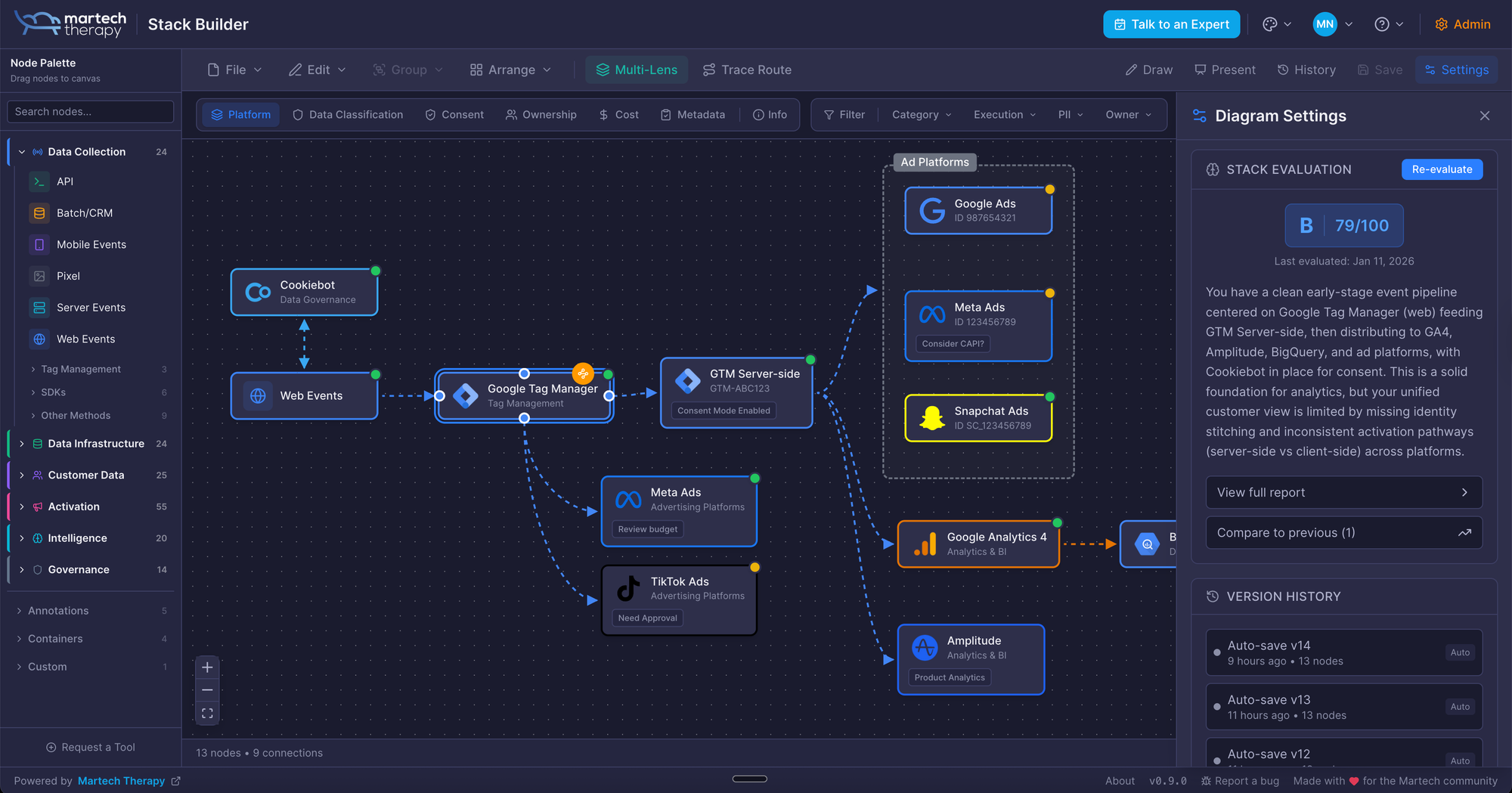
Version 0.9 feels like the first moment where that changes.
From a diagram to something that mattered
Martech Stack Builder began as a way to sketch Martech stacks without opening PowerPoint or Miro. Visual, flexible, almost playful. But the moment people started using it for real thinking, not just illustration, reality showed up faster than you can say "the Grinch stole Christmas".
Security stopped being theoretical. Refactoring wasn’t optional anymore. Data models mattered. Edge cases multiplied. “Vibe coding” is fun until you realise someone might actually rely on what you’re building to explain their stack to a CTO, a legal team, or a vendor.
At some point the question shifted from “can I build this?” to “does this hold up?”
Learning the hard parts the slow way
A lot of the progress since the early versions came from friction and not inspiration. Security work forced me to rethink assumptions I didn’t even realise I was making like secure webhooks, preventing prompt injections, and storing user data. Refactoring meant letting go of earlier shortcuts and constantly spending tokens on scans. Feedback became more important than features.
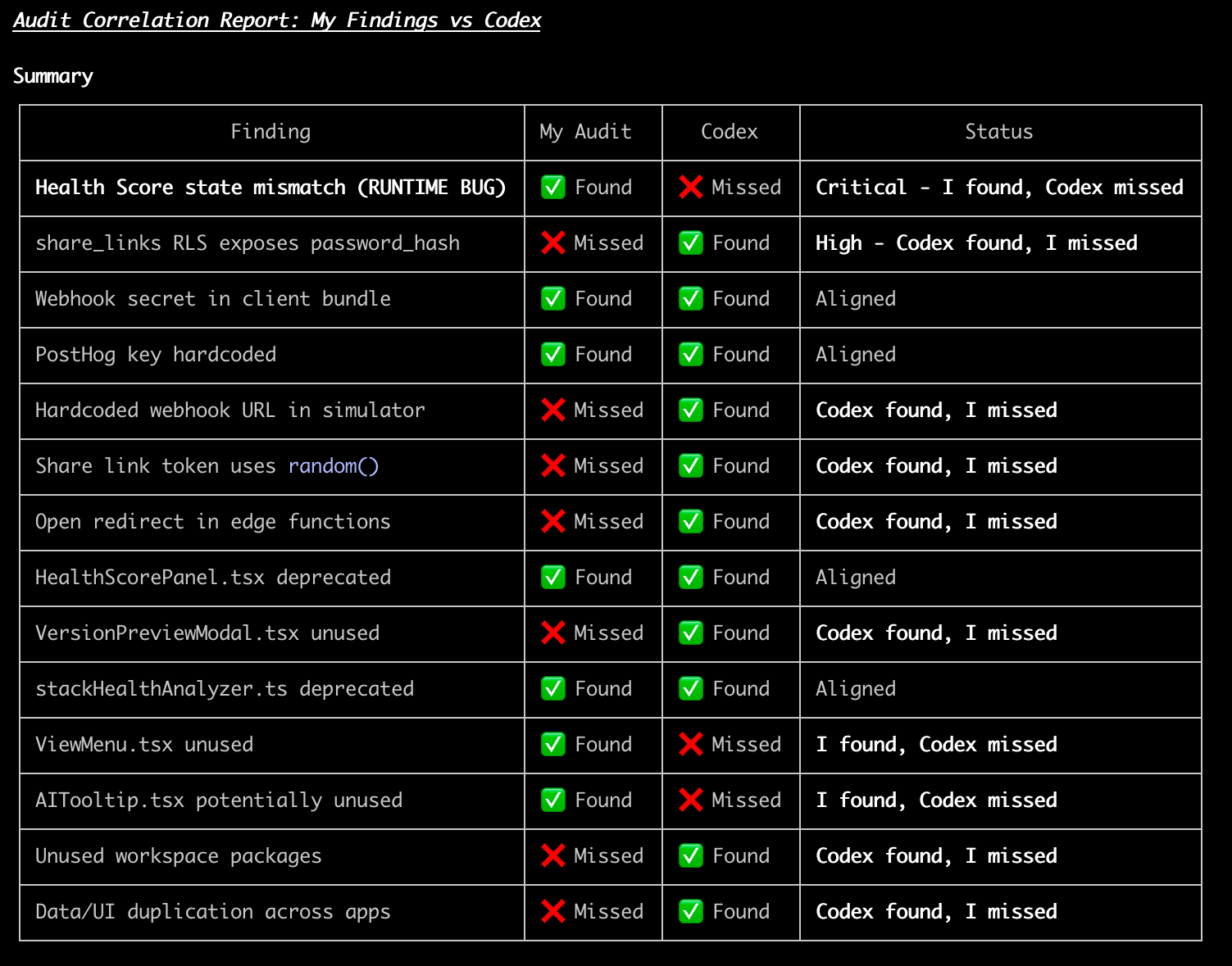
One person in particular deserves a mention here: Rune Andersen. He didn’t just poke around and say “nice tool”. He challenged flows, questioned defaults, and forced me to explain why certain things worked the way they did. That kind of feedback is uncomfortable, and yet incredibly valuable.
It also made one thing very clear.
The moment the product changed direction
The biggest shift in Martech Stack Builder wasn’t adding AI, templates, or even team concepts. It was realising that a Martech stack is never viewed through a single lens.
Data flows matter, but so do ownership, privacy, cost, responsibility, operational status, and organisational boundaries. All of those perspectives exist simultaneously. Most diagrams flatten that reality into a single view, and then we wonder why misunderstandings happen later.
A diagram without context is just a prettier slide.
The multi-lens approach
That insight led to the Multi-Lens model. Each node in the stack stopped being just a logo and started carrying meaning. Ownership. PII level. Cost signals. Status. Accountability. Dependencies.
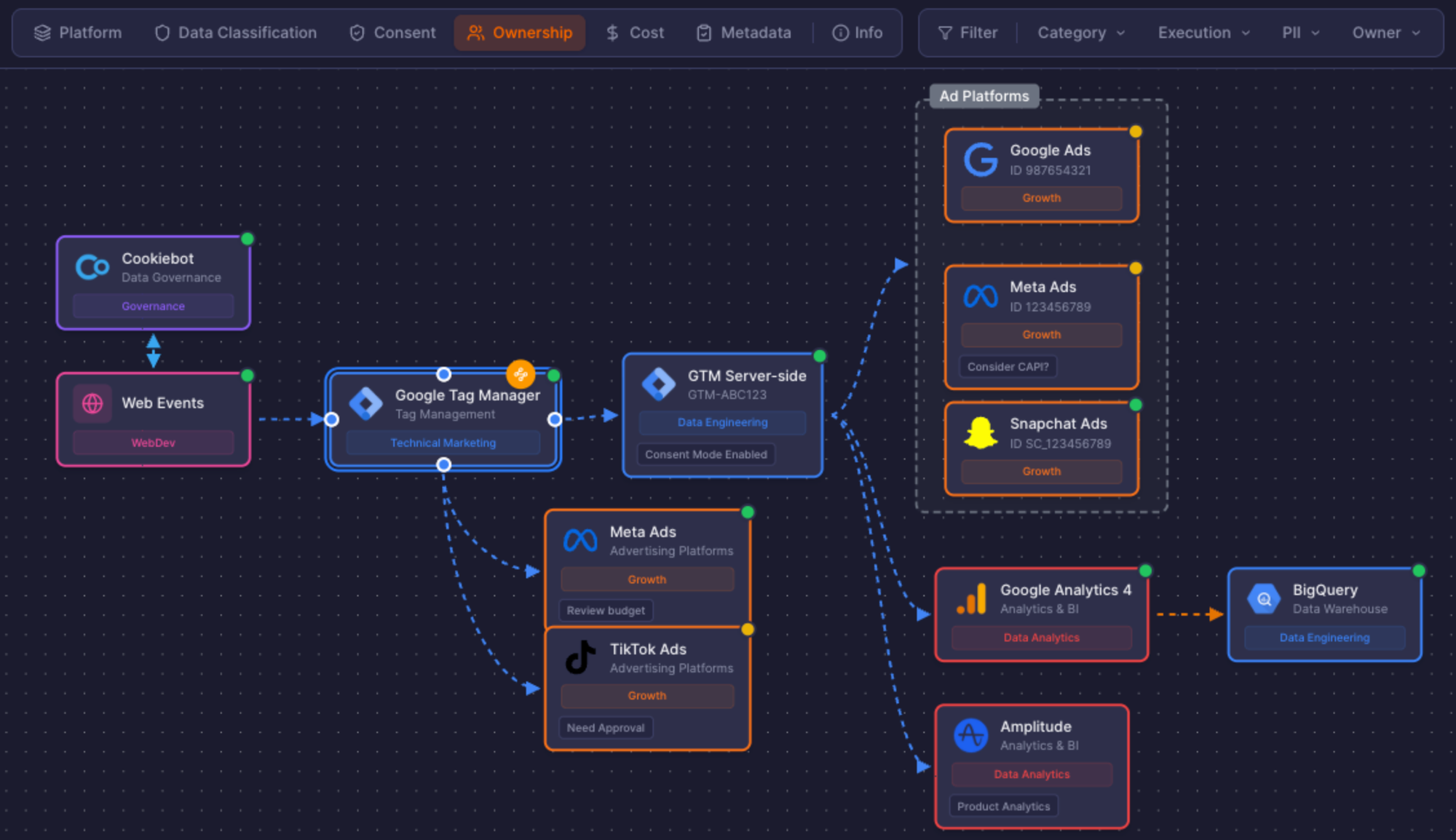
When you toggle between lenses, conversations change. You start seeing where responsibilities are unclear, where privacy assumptions live, or where costs accumulate quietly across teams. You don’t need another meeting to surface that tension. It’s already visible.
This was the moment Martech Stack Builder stopped being about visualisation and started becoming a sense-making tool.
Trace routes and uncomfortable truths
One feature that came directly out of this thinking is trace routing. It answers a deceptively simple question: where does data actually come from, and where does it go?
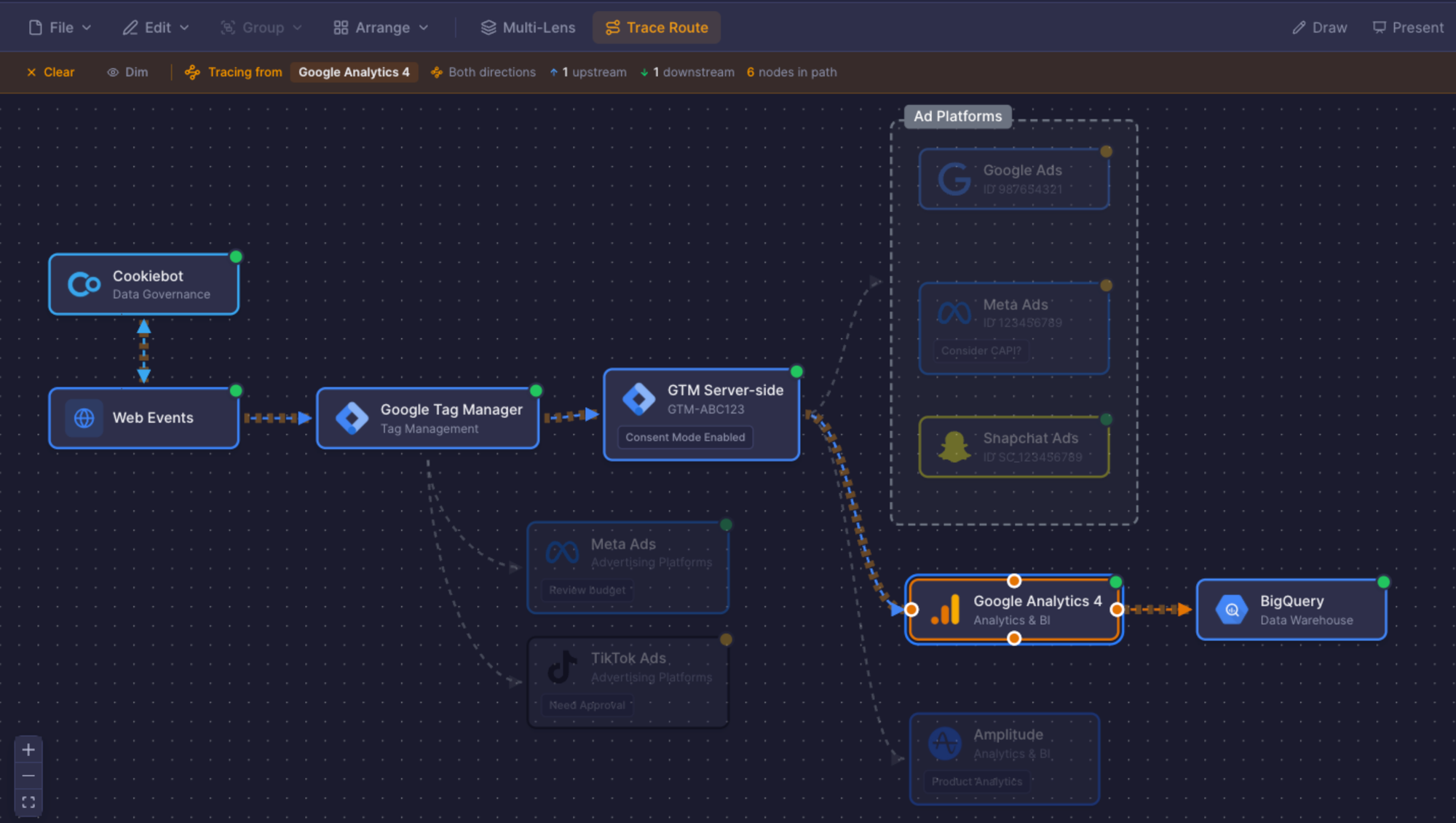
What surprised me was how often “connected” doesn’t really mean “downstream” or “dependent.” We connect tools on slides all the time without being precise about direction, responsibility, or impact.
The trace route feature still needs work. It exposes assumptions, and sometimes those assumptions turn out to be wrong. That’s exactly why it exists.
Yes, there’s AI (take a sip)
Let’s address the obvious part. Yes, there’s AI in Martech Stack Builder.
But it’s deliberately not the centre of gravity.

I still believe that designing Martech stacks is about business context, human judgment, and organisational reality. AI can help inspect, reflect, and accelerate thinking, but it shouldn’t replace it.
Right now AI is used in two places. First, to help generate initial stack templates so people aren’t staring at a blank canvas. Second, to evaluate a stack based on the information you’ve actually entered.
Evaluation as a living mirror
The evaluation feature doesn’t grade vibes. It reads what’s there. Node metadata, edge descriptions, ownership, privacy levels, cost indicators, status flags. The more context you add, the more meaningful the evaluation becomes.
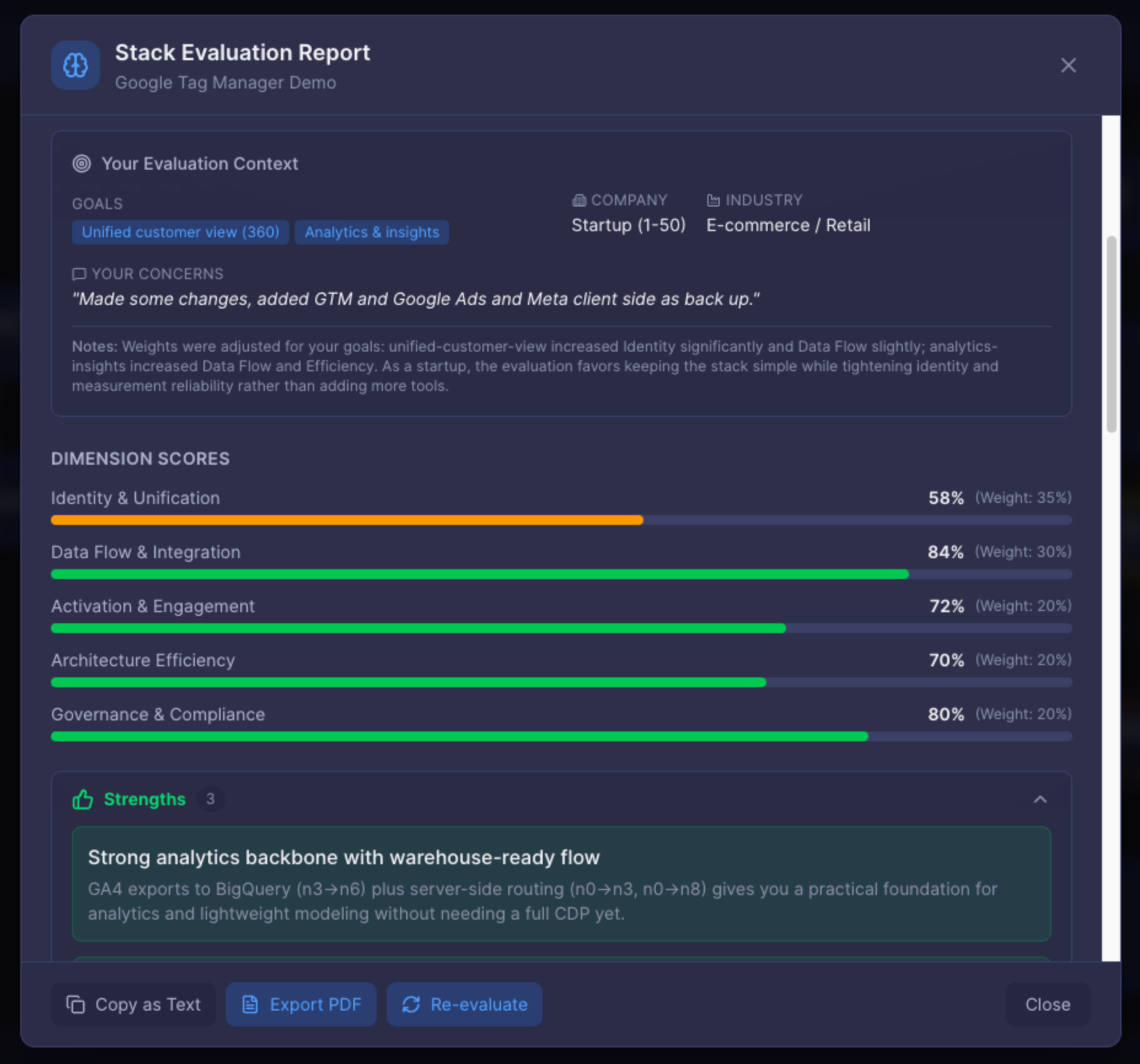
Over time this turns into less of a score and more of a mirror. You can see how your stack evolves, where risks reduce, and where complexity creeps in. Version history exists for a reason. Iteration should feel safe.
Why v0.9 is a pause before v1
At this point there’s enough in Martech Stack Builder to make it genuinely useful. There’s also enough unfinished thinking that calling this “done” would be dishonest.
Version 0.9 is a pause. A chance to invite friction before anything hardens into a v1 shape. Especially from people who don’t design stacks alone.
An open beta, genuinely open
That’s why I’m opening this up more deliberately.
There’s a three-month PRO coupon (BETA2025) that unlocks everything. Use it solo. Use it with clients. Use it in workshops. Break things. Question defaults. Tell me what doesn’t translate to real-world work.
I’m particularly interested in feedback from teams, consultancies, vendors, and in-house Martech groups who live with the consequences of stack decisions.
What I’ll be working on next
Two big areas are coming up next.
The first is team functionality. Shared diagrams, comments, collaborative iteration, and the ability to work on stacks together instead of passing files around.
The second is templates, but not generic ones. I want to work with vendors on officially approved, real-world architecture patterns that can be reused for training, onboarding, and honest conversations with customers.
Alongside that, I’ll be adding multi-layer diagrams. The idea is that you can drill into embedded solutions. For example, zooming from “Tag Management” into the internal structure of Google Tag Manager or Tealium IQ. This is inspired by software architecture approaches like the C4 model, where different abstraction levels coexist without losing coherence.
An invitation, not a launch
Martech Stack Builder isn’t trying to simplify Martech. It’s trying to make it visible and discussable.
If you’ve ever said “it’s more complicated than that,” you’re probably the right person to test this. Help shape it now, before it hardens into something fixed.

Start building your Martech Stack designs today 👇🏻
Use coupon code BETA2025 for 3-months free PRO access.
Discussion