


Reading this year’s Gartner Magic Quadrant for Customer Data Platforms gave me a familiar feeling.
Not, not that of reading a short novel, with its 46 pages. Not excitement. Not disbelief. More the quiet recognition you get when something you’ve been circling for a while finally lands on paper. The conclusions didn’t come out of nowhere. They arrived right on time for the category.
For years now, CDPs have been asked to stretch in every possible direction. Think of them as the industry’s Spandex. One moment they’re a data foundation. Then an orchestration layer. Then a governance mechanism. Lately, they’ve also become the supposed “context brain” for AI-driven marketing.
 Matthew Niederberger
At some point, you stop calling that versatility and start calling it an identity crisis.
This year, Gartner stops trying to keep all of that neatly bundled. Instead, it does something refreshingly un-analyst-like: it admits the category is splitting and gives both halves a name. The CDP market, according to Gartner, is forking into platformization on one side and agentification on the other.
That framing matters more than any single dot moving on a chart. It changes how the quadrant should be read, how vendor positions make sense, and how buyers should interpret what “leadership” even means in today's age. It also quietly sets up a second conversation, which I’ll come back to in part 2, about who drops out of focus when a market reshapes itself like this.
This didn’t start with the 2026 quadrant
If this split feels sudden, it’s only because the language finally caught up to Gartner.
Or because you’ve just quietly admitted to yourself that keeping up with the chaos of the last few years wasn’t exactly on your list of “important things to do”.
And honestly, I don’t blame you. I’ve had moments of wanting to give up, too.
Earlier Gartner research kept circling the same unresolved questions. Composable versus suite. Marketing ownership versus IT ownership. Activation speed versus governance depth. Pricing models that sounded perfectly reasonable in vendor presentations, right up until someone asked how they would scale in year three without triggering a conversation with procurement.
Oh, if I could only get a Dollar Euro every time I heard that question pop up.
I’ve written about these patterns before, often while sitting in demos where everything looked smooth, fast, and oddly consequence-free. The tools usually weren’t the issue. The expectations were, and still are.
What’s different this year is that Gartner no longer tries to smooth those contradictions into a single storyline. It acknowledges that the category has been pulling in two directions at once, and that pretending otherwise hasn’t helped buyers make better decisions. At least not from where I’ve been sitting, often facepalming during demos.
And I can't tell you what a breath of fresh air this is.
Layer one: platformization
The first path Gartner describes is platformization.
Here, the CDP isn’t a standalone marketing product. Was it ever, really? It’s a foundational layer inside a much larger application ecosystem. The value of the CDP grows as more of the surrounding platform is adopted, because it becomes the shared customer context everything else depends on.
This is the 'suite' territory of Salesforce, Oracle, and Adobe.
In this model, the CDP acts as connective tissue. Consent updates ripple through the system. Identity rules are enforced consistently. Decisions made in marketing can trigger actions in sales or service without brittle integrations or manual handoffs. From an enterprise perspective, this is deeply appealing.
It does come with gravity, something I’m getting to know quite well on the brink of turning 50.
Platformization assumes commitment. Architectural commitment. Commercial commitment. Organizational commitment. Capabilities are often tied to adjacent products. Pricing unfolds in layers. Flexibility exists, but mostly within the boundaries of the ecosystem... which can feel limited, even with the above mentioned giants of industry.
For large, regulated organizations, that trade-off often makes sense. Predictability and control outweigh experimentation. The CDP becomes less a tool and more an internal operating system.
That’s a valid future for the category. It’s just not a casual one.
Layer two: agentification
The second path Gartner outlines is agentification, and this is where the category starts to feel genuinely different.
In this model, the CDP is deliberately slimmer. Its job is to unify customer context, expose decisioning logic, and connect to activation points. It does not try to become a full application suite. Execution increasingly lives with AI agents operating on top of that foundation or other integrated intelligence.
 Matthew Niederberger
This approach aligns closely with warehouse-native and composable architectures, where customer data already lives in cloud platforms and the CDP activates it without copying it all over the place. Less duplication, fewer moving parts, more reliance on what’s already there. Ah, don't get me started on the semantics of this...
The promise here is autonomy. Agents pursue outcomes rather than campaigns. Humans define objectives and guardrails, and the system continuously adjusts decisions across channels. Less calendar-driven marketing, more continuous optimisation. Trust me, you need to see this to believe it.
This is why Hightouch landing in the Leaders quadrant matters more than it might first appear.
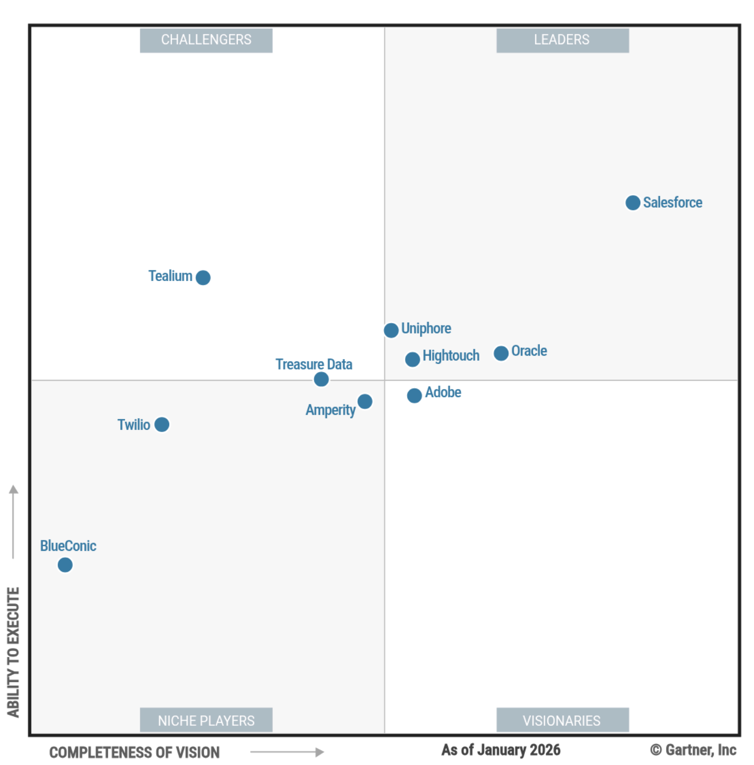
Before this Magic Quadrant was published, I ran a small experiment using Gartner Peer Reviews data to simulate how vendors might land if buyer sentiment and architectural fit carried more weight. In that simulation, Hightouch already showed up in the Leaders quadrant. Not because it tried to do everything, but because it was very clear about what it was trying to be.
This year’s quadrant quietly confirms that direction.

And yes, that kind of visibility still matters. Especially in boardrooms and industries where analyst reports continue to carry real weight. I’ve written before about how Gartner and similar reports still shape decisions in regions like the Middle East, where “Leader” is more than a badge, it’s a shortcut to trust.
Does this newly found fame mean Hightouch will open a Middle East office next? Just kidding.
Or am I.
Jokes aside, I’m comfortable saying that this Leader position will put Hightouch on the radar in rooms where these reports still open doors.
Hold on to your hats, though. Gartner is treading carefully. Agentification is framed as an emerging operating model, not a finished one. Which is fair. Agents still rely on existing execution systems. Reliability, governance, and explainability remain open questions. The ambition is obvious. The operational reality is still catching up, like us humans.
Which, if we’re honest, is exactly where most interesting technology categories spend a few uncomfortable years.
Why the middle starts to thin out
Once you accept this two-path framing, something else becomes easier to see.
There isn’t much stable ground between platformization and agentification.
Vendors that sit in the middle often execute well today, but struggle to explain where they’re heading structurally. Are they building toward deep platform gravity, or toward autonomous, outcome-driven systems? Trying to do a bit of both usually results in awkward compromises.
 Matthew Niederberger
Is this what happened to mParticle by Rokt, Zeta Global, and Red Point Global?
Now, don’t get me wrong here. This isn’t a judgement on effort or intent. I am no Judge Dredd.
What it is is category physics.
A CDP that is partially composable and partially suite-driven can end up expensive without being liberating, and flexible without being truly orchestrated. Be honest, how good can a feature really be if you’re sharing your focus across everything except a clear core offering?
Innovation still happens, but it feels incremental rather than directional. Buyers sense progress, yet still wonder why things feel heavier than expected.
The quadrant reflects this, even when it doesn’t spell it out.
What this quietly changes
The most important change in this year’s Magic Quadrant isn’t a dot moving left or right. I'm sure we've got more important things to worry about on a daily basis.
What matters is the admission that CDPs are no longer competing along a single path toward “better”. They’re diverging into different operating philosophies, each with its own demands on teams, governance, and patience.
That changes how Leaders should be read. It changes what vision actually signals. And it raises an uncomfortable question about who this market is increasingly designed for.
That question deserves its own space.
In part 2, I’ll look at what this split means for buyers outside the global enterprise bubble, and why the absence of the mid-market in this conversation is more revealing than any single vendor ranking.
For now, the takeaway is simpler. The CDP category didn’t suddenly become clearer this year. It became more candid.
And in my experience, that usually happens right before things get interesting.
Your stack isn’t failing.
It’s absorbing more effort than it used to.
The Second Law of Martech scan helps you see where organisational energy is being spent just to keep things working, and where that cost is starting to crowd out real value.
Discussion