


I’ve been reading Databricks' and Scott Brinker’s recent paper on the New Martech Stack for the AI age. It’s one of those pieces that, just like studying astronomy, feels both clarifying and slightly unsettling at the same time.
Clarifying, because it puts words to something many of us have been feeling for a while. The stack is creaking. Integration is still eating time and energy. Data sits everywhere, but rarely works together in the way we need it to. So, the idea of moving toward a shared data foundation, with agents operating across it, makes intuitive sense.
And unsettling, because it quietly assumes a starting point that not every organization recognizes.
The direction is right. The distance is underestimated.
A future that already exists
What Scott outlines is not hypothetical at all. Parts of this architecture are already in place in some organizations.
A unified data foundation where customer, company, and content data come together with a semantic layer that creates shared meaning. Feeding agents that can act across systems, not just report on them, and decisioning that moves closer to real-time, informed by context rather than predefined journeys.
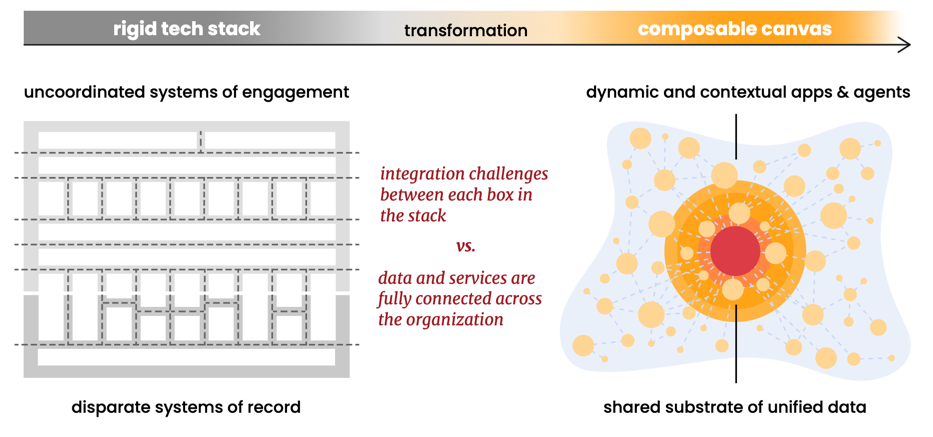
If you’ve spent time in larger enterprises or data-mature environments, this will feel familiar. You probably have the “been there, done that” t-shirt. The pieces are there, and the shift is already happening.
The paper, or ebook as it is called (probably because of its length), captures that trajectory well. It gives structure to what can otherwise feel like a fragmented set of trends that we all seem to be struggling over to apply in our daily professional lives: AI, composability, data platforms, and agentic workflows.
It paints a compelling picture.
The starting point matters
Where things get more complex is when you look at where most organizations start. In many cases, the reality looks more like this:
Customer data is spread across CRM, ESP, analytics, and a handful of point solutions, not to mention teams and definitions that vary depending on who you ask. Dashboard insights that don’t quite align and integrations that work, until they don’t... usually on Friday afternoons.
The idea of a shared data foundation is not unfamiliar. It’s just not fully formed yet.
The same goes for skills and ownership. Many marketing teams operate with a small core of specialists, supported by vendors and agencies. Data engineering and model governance are not always embedded capabilities and decision-making is often distributed across teams and pay grades, each with its own priorities and metrics.
None of this is unusual. It shouldn’t be if you have soent time in the frontlines of Martech. It’s just how most organizations have grown.
But it does mean that the composable canvas is not something you step into overnight.
Distance, and gravity
There’s a concept in astronomy that I’ve always found fascinating. Parts of the universe are moving away from each other so quickly that, even at the fastest possible speed, cosmic expansion will never allow them to interact. There are parts we will never see because the expansion exceeds the speed of light.
Martech can feel a bit like that right now. Martec's Law in overdrive.
Let's acknowledge that data gravity is real. There’s a clear pull toward bringing data together, creating shared context, and building systems that can act on it. At the same time, organizational distance is just as real. Different teams, different tools, different ways of working, all evolving at their own pace.
Scott’s composable canvas describes what happens when those forces align.
In many organizations, the reality is that they are still catching up with each other.
 Matthew Niederberger
The broader market reality
There’s also a practical dynamic at play in the industry itself.
A lot of the conversation around composability, data platforms, and AI-enabled marketing is shaped by what is possible at the upper end of the market. Large enterprises with dedicated data teams, significant investment capacity, and the ability to rethink architecture over multiple years.
Consultancies and vendors naturally gravitate toward these environments. This is where the big contracts are ripe for the picking. At the tip of the market, the impact becomes visible, projects are transformative, and outcomes are easier to showcase. Full circle, all in time for the next wave of candidates.
For the rest of the market, the path tends to look more incremental and uphill. That doesn’t make the vision less relevant, but it changes how it needs to be approached.
Becoming composable over time
What I find interesting is that you don’t need the full canvas to start working in a more composable way. That is pretty much a composable selling point.
In practice, progress often begins in smaller, more focused areas.
A team improving how activation connects to data, without rebuilding the entire foundation or introducing agent-assisted workflows in a specific use case. Bringing more consistency into how metrics are defined and used across teams or creating pockets of decisioning that are closer to real-time.
These steps don’t immediately transform the architecture overnight; however, they do start to change how the organization operates.
Over time, those changes compound. Just not at speeds we are used to seeing in demos or whitepapers.
The composable canvas, eventually, becomes less of a target state and more of a direction of travel.
 Matthew Niederberger
Where this leaves us
The New Martech Stack of the AI Age does something valuable. It gives the industry a shared reference point for where things are heading. It connects a number of important developments into a coherent model.
At the same time, it nevertheless raises a question that I think is worth sitting with:
If this is the direction, how far are we from being able to operate this way?
For some organizations, the answer is “not that far.”
For many others, there’s still work to do in how data is structured, how teams collaborate, and how decisions are made.
That gap isn’t a problem to solve in one go. It’s a collaborative journey.
And that’s where most of the real work in Martech still happens.
A final thought
In theory, everything can be connected. Data can flow, agents can act, and systems can adapt in real time. In this day and age, marketing technology is not the challenge.
In practice, progress depends on how close an organization is to being able to support that.
The composable canvas is a useful map.
Most of us are still somewhere on the road toward it.

Start building your Martech Stack designs today 👇🏻
Discussion