


In the first part of this series I defined the agentic CDP as a platform you mostly stop operating by hand, where you set the goals and the limits and check the work. Without many of you realizing it, that sentence hides a career change, so this part is about the job on the other side of it.
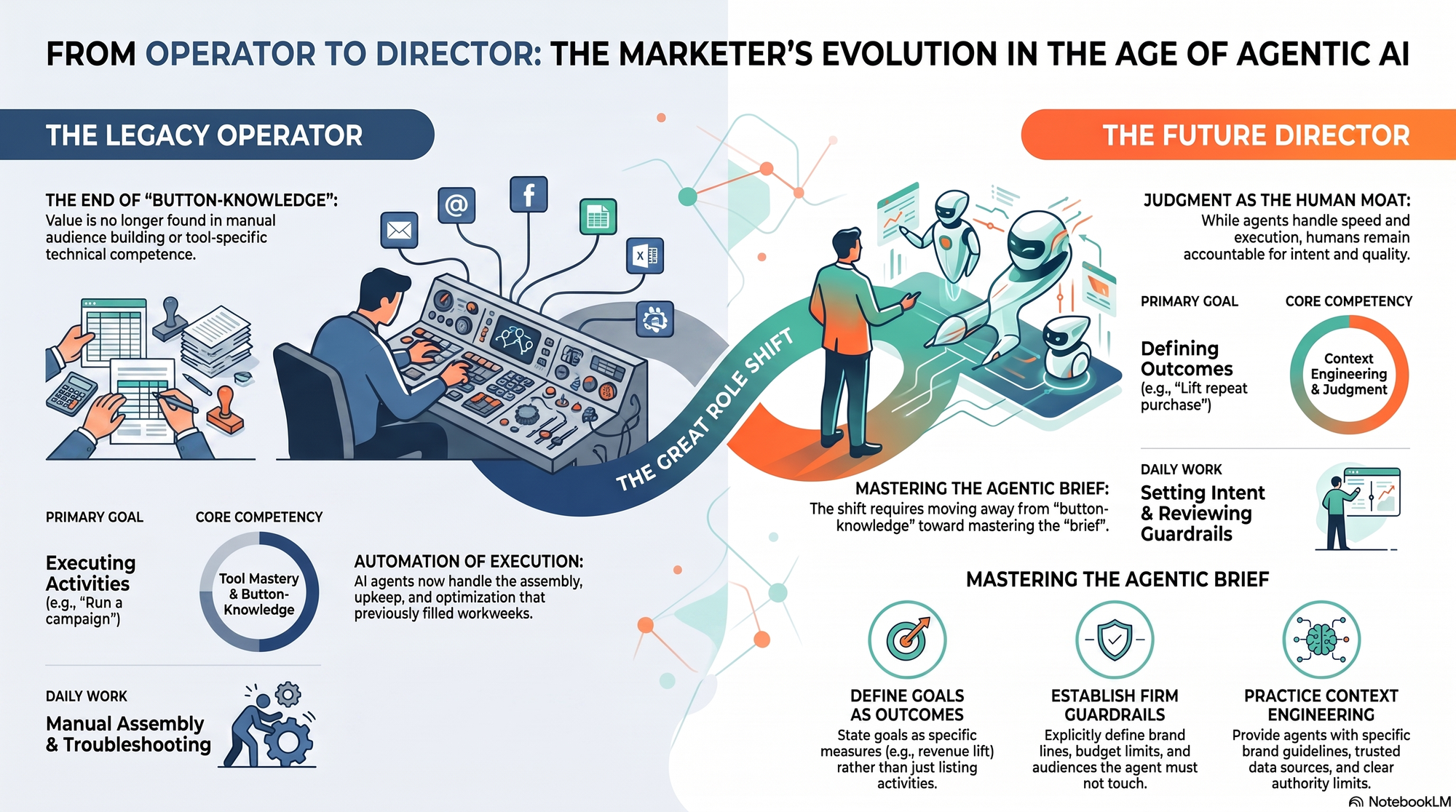
For about a decade, being good at martech meant being good at the tools. You knew where the audience builder kept the condition you needed, you could get a journey out of the platform without filing a ticket, you remembered which export broke if you sorted it the wrong way. That competence took years to build, and it is about to matter much less. The agent knows the buttons. What it does not have is your judgment about what to build and whether the result is any good.
 Matthew Niederberger
Read my previous series about agentic AI in Martech ☝️
What the agent actually takes
The vendors are clear about which tasks they are taking.
- Simon AI splits its product into three sets of agents, one for strategy, one for data execution, one for revenue impact, which is a neat map of the operator work moving across the table.
- GrowthLoop keeps a no-code audience builder in front of the marketer and lets its agents assemble and optimize the segments behind it.
- Databricks ships Campaign Agents that build audiences, recommend next actions, and keep tuning a campaign after it launches.
If you manage to read past the marketing lingo, you'll see that they are automating the same thing: the assembly and the upkeep of the campaign, the work that used to fill your week.
If your value to the organization was that you could operate the platform, that value is depreciating. This is the uncomfortable part, and it is worth saying plainly rather than dressing it up. The button-knowledge era of martech is closing. So much for all those certifications... but don't despair.
What stays yours, and gets harder
What does not automate is the part that decides whether any of it works.
Start with intent: saying what you actually want in terms an agent can act on. That is harder than it sounds, because most campaign goals are vague the moment you try to write them down.
Then there are the guardrails, the things the agent must not do, your brand lines, your frequency limits, the offers it cannot make, the audiences it cannot touch.
And underneath both sits judgment: looking at what the agent produced and knowing whether it is good, off-brand, or wrong in a way that is easy to miss.
None of those is a button. They are skills, and most marketers have had little reason to practice them until now.
It is fashionable to frame this the other way around. Writing about the same launches, MarTech.org's guest writer Mike Pastore caught the vendor logic neatly:
Where the first CDPs treated data as the problem, the agentic pitch treats the human as the blocker, too slow to analyse and decide. There is something to it, speed is real.

But the framing assumes the slow part was the valuable part, and it was not.
The valuable part was the judgment, and judgment does not get faster by removing the person who holds it.
So the job is not disappearing. It is moving up to intent, guardrails, and judgment, and you are still accountable for the result even though you are no longer the one assembling it.
If you are in doubt, let me just emphasize that that is a promotion. 🎉
It is also a promotion most marketers have not been trained for, because the old job rewarded operating the tool, not directing something else to operate it.
This is something Dojo AI saw coming from mile away. The intelligent marketing system that Duarte Garrido and António Alegria are building boils down to this 👇🏻
Take the assembly off the marketer's plate so the craft and the judgment are what is left.
Garrido ran marketing at Coca-Cola and Sky before this, and when he and Alegria came on my podcast Couch Confidentials they clearly stated, based on experience, that most stacks bury the craft under tool-wrangling. They were guests on the podcast, so weigh the endorsement with that in mind, but I think the direction is right, and the agentic CDP is one more reason the wrangling should not be the job.
 Matthew Niederberger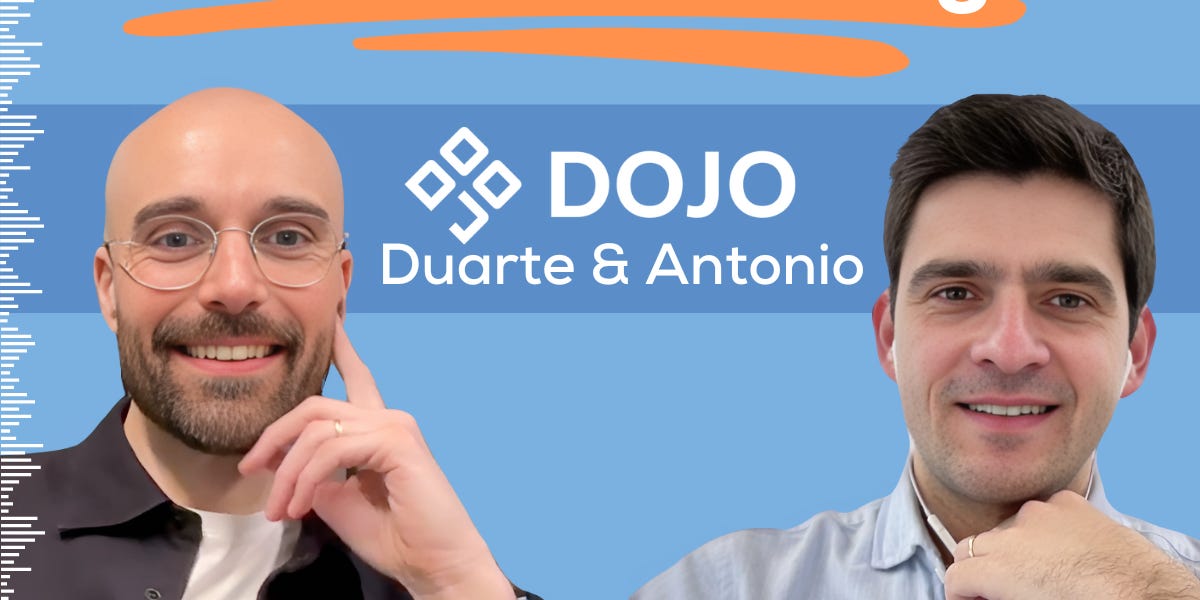
The brief is the new core skill
The practical version of all this is learning to write a brief an agent can use. You already write briefs, for agencies, for designers, for your own team. An agent is a more literal reader than any of them, and it will do what you said rather than what you meant.
This is not only a marketing observation. Ethan Mollick, who studies this at Wharton, argues that managing agents is the real AI skill, and his checklist for delegating to one, what you are trying to achieve, where the agent's authority ends, what done looks like, and what to check before it finishes, maps almost exactly onto a campaign brief.
The marketing version has a few parts. It states the goal as an outcome and a measure, not an activity, for instance lift repeat purchase among lapsed customers by the end of the quarter, not "run a win-back campaign." It names the audience and the data the agent should trust, and the context it should read first, your brand guidelines, the positioning, last quarter's results. It sets the limits in plain terms, the budget, the send frequency, the channels in and out of bounds, anything off the table. It says what the agent may decide on its own and what it has to bring back to you. And it says how you will check, what you want to see before launch and what you will review after.
Keep it to a page. If you cannot fill in the goal or the limits, you are not ready to hand the campaign over, which is a useful thing to find out before the agent finds it out for you.
Why this is a capability problem
This is a readiness gap more than a technology one, and it sits in the capability column of my Martech Readiness framework. The agent rarely fails because the technology is weak. It fails because no one briefed it well, or because no one could tell its good work from its confident mistakes.
Scott Brinker calls this new skill context engineering, bundling the instructions, data access, and permissions an agent needs to act, and his 2026 survey work puts the top blocker not on the models but on the data marketers feed them. Both point the same way:
The constraint is rarely the agent, it is whether the marketer and the organization are ready to direct it.
I wrote a while back, in Letting go of control, that moving to agents is a leadership question before a technical one, the same discomfort a manager feels the first time they hand real decisions to a new hire. The way out is the same as well. You get better at delegating by delegating, on small things first, with the brief tight and the review honest.
I called an earlier version of this contextual fluency in the Contextual CDP series, and the wider argument about agents and trust runs through the Agentic AI in Martech series. This part is the narrow, practical corner of it, the "where do I start?" brief on your desk on Monday.
 Matthew Niederberger
Context Engineering, Contexual Fluency, make sure to get ahead of the market.
You can start before the platform arrives
The good news is, none of this needs the tool yet. You can practice writing the goal as a measure, drawing the guardrails, and judging output on the campaigns you already run by hand, and you will be readier than most when an agent shows up to do the assembly. The marketers who struggle with agentic CDPs will be the ones who never learned to say clearly what they wanted or to tell good work from bad. Sounding like a broken record, knowing the software was never the hard part.
Next week, part 3, what to demand from the platform itself when you are the one signing for it, and how to tell a tool built for you from one built for the vendor's slide.
Do you have any questions after reading this article?
Or need support with your Martech projects?
Discussion