

A category that shipped last quarter is already being talked about as though it has always been here, with the vocabulary written in advance by the companies selling it. Who would blame them? I, too, made that point in passing when I looked at how three engagement vendors handed their data layer to Databricks, and it is the reason for this series.
I am going to spend five parts taking the agentic CDP apart slowly, because right now there is almost nowhere neutral for a marketer to work out what the term means or what it asks of them.
Here is the bet this series will make 👇🏻
Everyone from Gartner to the vendor keynote will tell you what an agentic CDP does. Far fewer will tell you what it does to your job, and that second half is what decides whether any of the technology pays off. So the series weights toward the half that decides whether it works: the marketer, the skills, and whether your organization is ready to hand real decisions to software.
The label is older than the launch, really.
The collision that put "agentic CDP" on everyone's slides happened in June 2026, when Hightouch reframed its whole pitch around the agentic CDP a day before Databricks announced CustomerLake at its Data + AI Summit. I wrote about the Databricks side of that when CustomerLake launched, so I will not repeat it here.
 Matthew Niederberger
Read my thoughts on the Databricks' CustomerLake announcement here ☝️
What the launch coverage skips is that the term is older than the giants who made it famous. GrowthLoop called itself the agentic, composable CDP back in April 2025. Simon Data relaunched as Simon AI around an agentic marketing platform that September. Treasure Data went furthest, renaming itself Treasure AI in April 2026, billing itself an agentic experience platform, and renaming its CDP World conference to Agentic World.

The analysts ratified it in parallel, Forrester naming the paradigm and Gartner's 2026 Magic Quadrant describing a market splitting into platformization and agentification. By the time Hightouch and Databricks arrived at the scene, the early movers had coined the term, the analysts had blessed it, and the giants made it impossible to ignore. So, prepare yourself for those vendor demo's 😉
Surprise, the definition was written by a vendor
Search "what is an agentic CDP" and the top result is CDP.com, which presents itself as "your independent resource for understanding Customer Data Platforms".
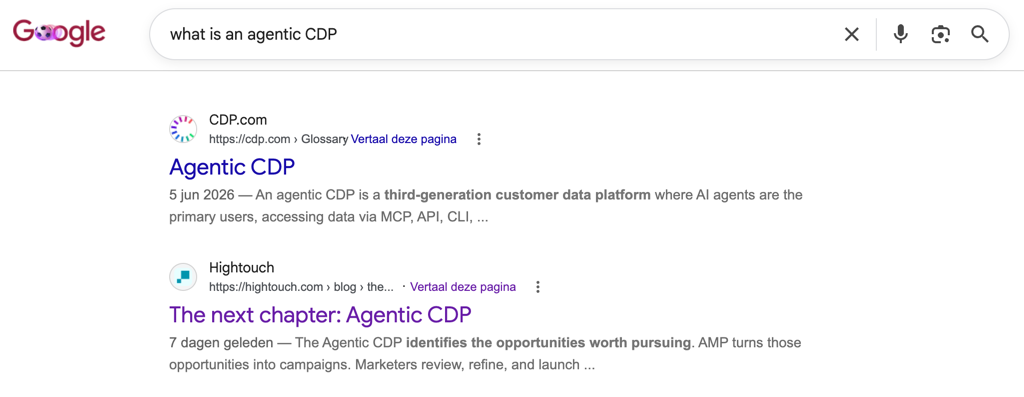
Read to the footer and you find it is managed by Treasure Data AI, and the definition itself is written by Kazuki Ohta, Treasure AI's co-founder and CEO.
It is a genuinely thorough page, and I enjoyed reading Kaz's thoughts. But, to be fair, it is also a sales document.
It sorts the market into three stages, packaged then composable then agentic, and runs a five-point "litmus test" for a real agentic CDP whose criteria, native messaging, a closed loop inside one platform, a sub-second profile store, line up exactly with... wait for it... how Treasure AI is built. Then it scores the field:
Treasure AI five out of five, Databricks two to three, Hightouch one.
A test written by a vendor, which the vendor passes perfectly, and its largest rivals fail. I will let you decide the level of objectiveness you are witnessing.
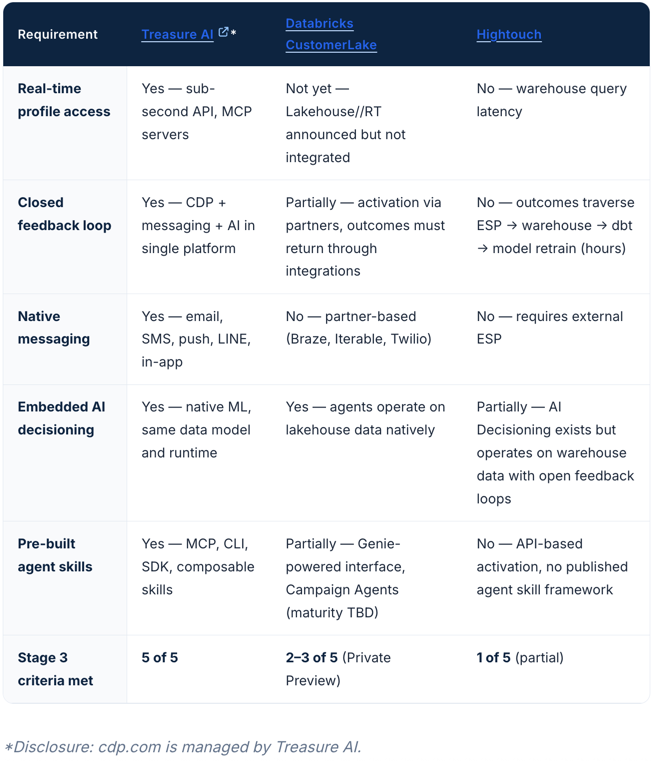
Now, let's pause for a second. The scorecard admits something its author did not intend. By the strictest definition going, the one written to flatter Treasure AI, the most-hyped products on the market score one and two out of five. The agentic CDP is real as a direction. It is mostly not a shipping product yet, and that is worth knowing before anyone signs for one.
Real Story Group's Tony Byrne goes a step further and argues that the agentic, decisioning part is separating into its own layer above the CDP rather than living inside it, a question part 3 picks up.
To be fair where fairness is due, parts of it are really sharp. Its read on Hightouch, that the label changed and the architecture did not, is the same conclusion I would draw. But that is the point of the whole series in one example. The reference everyone will send your CEO is a marketing asset wearing a lab coat, and there is almost no neutral education sitting next to it. That gap, between what the technology can do and what a buyer can actually understand and absorb, is Martech's Law, and AI is widening it faster than anything I have watched.
When the people defining a category also sell it, a definition you own yourself is worth more than usual.
 Matthew Niederberger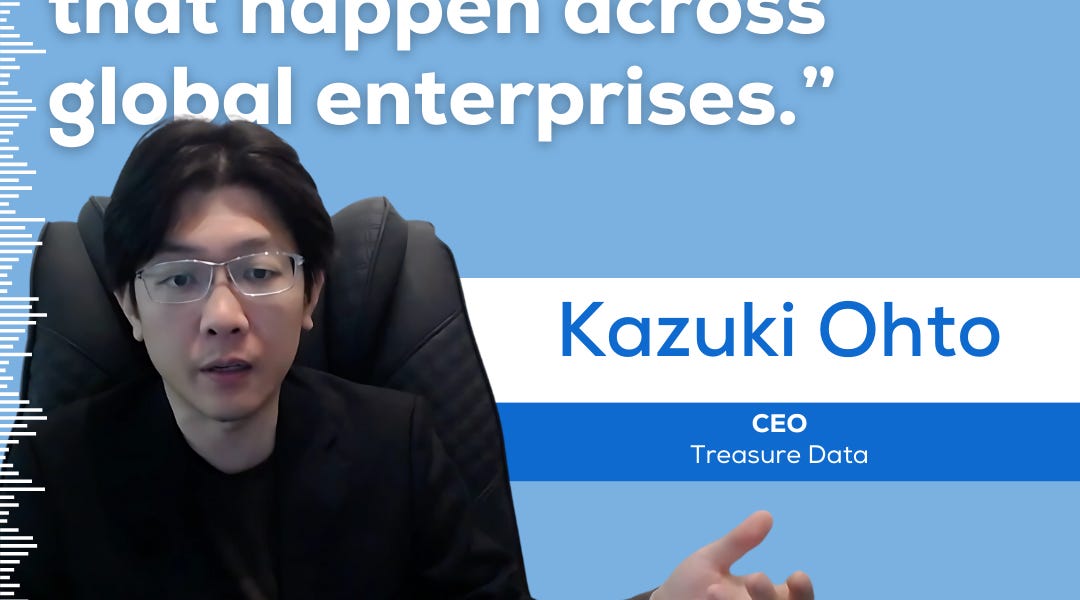
Watch my interview with Treasure AI CEO Kazuki Ohta ☝️
What it actually is, in plain terms
David Raab, who named the CDP in 2013, has been making one point for a while:
The most important reader of a unified customer profile is no longer a human analyst, it is an agent.
The vendor definitions build on that and quickly turn into architecture diagrams. The version I would hand a marketer is plainer 👇🏻
An agentic CDP is a customer data platform you mostly stop operating by hand. AI agents read your unified customer data, decide who to target and what to send, run the campaigns across your channels toward goals you set, and report back. You stop building campaigns and start directing them: setting the goals, setting the limits the agents work within, and checking what they produce. You are still accountable for the outcome, even though you are no longer the one clicking.
Agentic, or just renamed?
Every CDP on the market will have "agentic" on the homepage by autumn, and most will be packaged platforms with an assistant bolted to the side. The CDP.com litmus test sorts them by one vendor's architecture.
Here is a version that sorts them by whether they fit your job.
Start with who the platform is built to be operated by. If the honest answer is still a person clicking through a builder, with a chat box added for show, you are looking at a packaged CDP with imposter syndrome.
Then look at what the agent is allowed to decide on its own versus what it has to bring back for sign-off, because a system that can only ever suggest is an autocomplete, not an agent.
The third question is reach: can it act across the channels you actually use, or only inside its own walls?
And the last one gives the game away, where the goals and the measurement live, because an agent with no goal to chase and no clean signal to read is an expensive way to generate first drafts.
Part 4 is built around that one, the importance of measurement, because it is the question the whole category is leaning on and the one most organizations answer worst. I am feeling excited about this one since it will take me back to my digital analytics roots.
Run those four at your next demo and the renamed CDPs sort themselves out fast.
Why this is a readiness question
Notice that none of those four questions is really about the vendor. Each lands back on you.
Whether the agent can read your data depends on what state your data is in.
Whether you can brief and judge it depends on whether your people know how.
Whether it can act safely depends on whether your campaigns have goals and guardrails worth acting inside.
Structure, capability, process, the readiness series treats these as the main event rather than a footnote, the marketer who can actually direct this kind of system rather than be sidelined by it.
That is the case for embracing this rather than bracing against it. The agentic CDP is not a thing being done to marketers. It is a set of tools that reward the teams who got ready and expose the ones who did not, and getting ready is mostly work you can start now, before the contract, before the migration, before a keynote convinces your CEO that the tool will fix a decade of neglected data on its own. The category is early, and that is the opportunity. Getting ready now is a head start on a market that is mostly still a lot of banter.
So here is where this goes. Five parts, weekly, each ending with something you can use. This one defines the term "agentic CDP". Then the job it hands you, what to demand when you buy one, how to keep your brand while agents run your channels, why measurement becomes the difference between steering and drifting, and a readiness check you can run on your own organization. The thread through all of it is that an agentic CDP changes your responsibilities at least as much as it changes your stack, and the marketers who see that early are the ones who get the most out of it.
Next week, Part 2, the job that lands on you when the agent does the building, and why "director" is a promotion most marketers are not yet set up to accept.
Do you have any questions after reading this article?
Or need support with your Martech projects?
Discussion