


You already know your stack ships more than your team can keep up with. That is not the interesting part, and it is not why I have been chewing on this for months.
The interesting question is whether AI is about to help with that or make it worse. Not in the abstract, but for the specific job of staying current with everything your tools ship after you have signed.
Here is the perspective I keep reaching for. Scott Brinker named the shape of this more than a decade ago and called it Martec's Law, yes, without an 'h'.
Technology changes exponentially. Organizations change logarithmically.
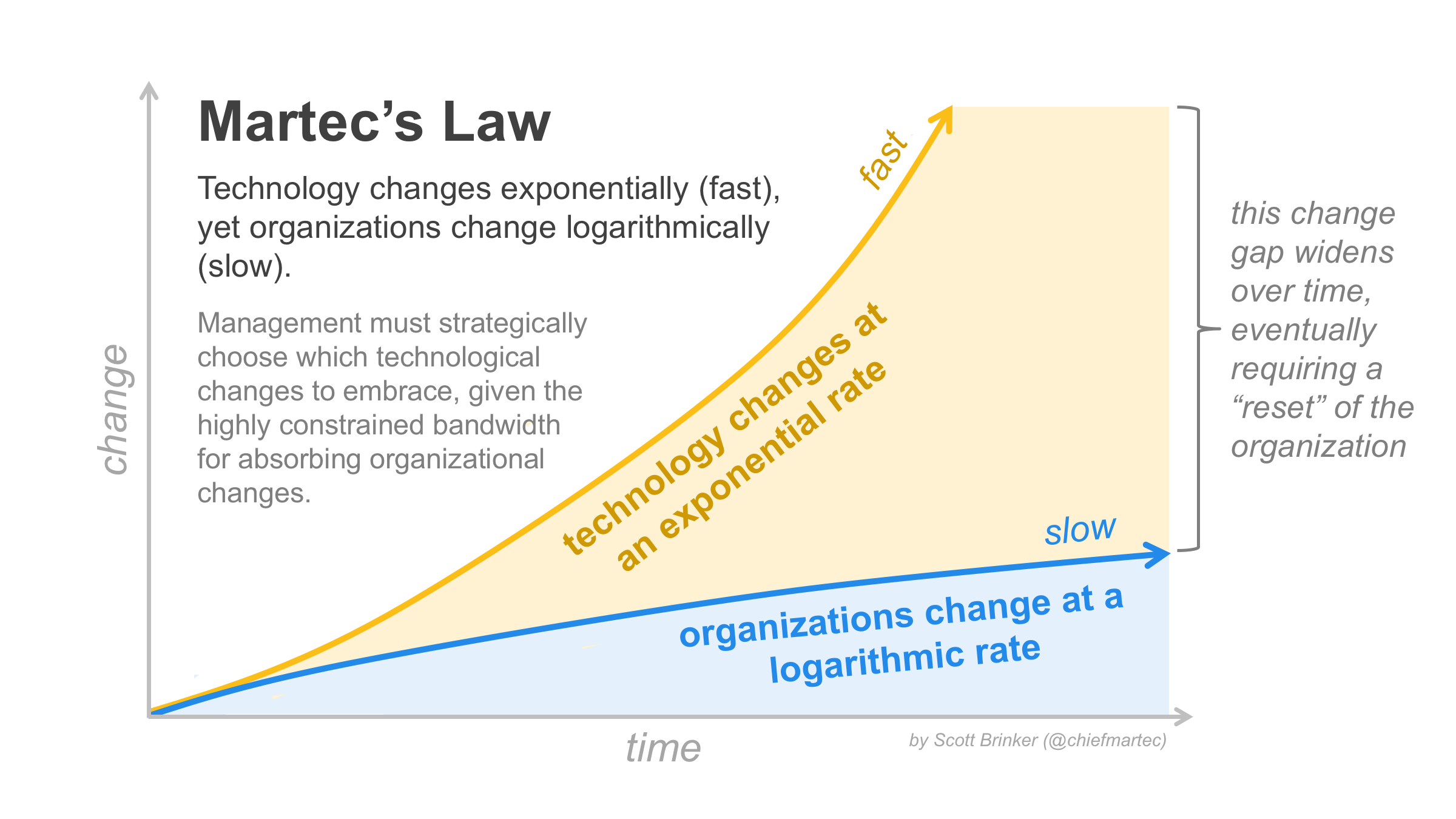
Two curves pulling apart, with you stretched between them. The common perception of AI is that it steepens the technology curve, so the gap gets worse. That is probably half right.
My interest is in the other curve. For the first time, something can push on the organisational side of the law, the slow one that Brinker said only creeps along. That is either very good news or a new problem dressed as good news, and I honestly cannot tell you yet which one it is, yet. Hindsight after all is 20/20.
The cost, priced
Before the AI question, the bill, because it is larger than people expect and almost nobody puts a number on it.
A while back, I worked through a hypothetical with an industry peer about vendor roadmaps. If a vendor ships one major feature and four minor ones a quarter, what does it cost your team just to stay current, or even to judge whether those features matter to your business model and architecture? Take a small company running 20 tools. That is 80 major features and 320 minor ones a year crossing your desks.
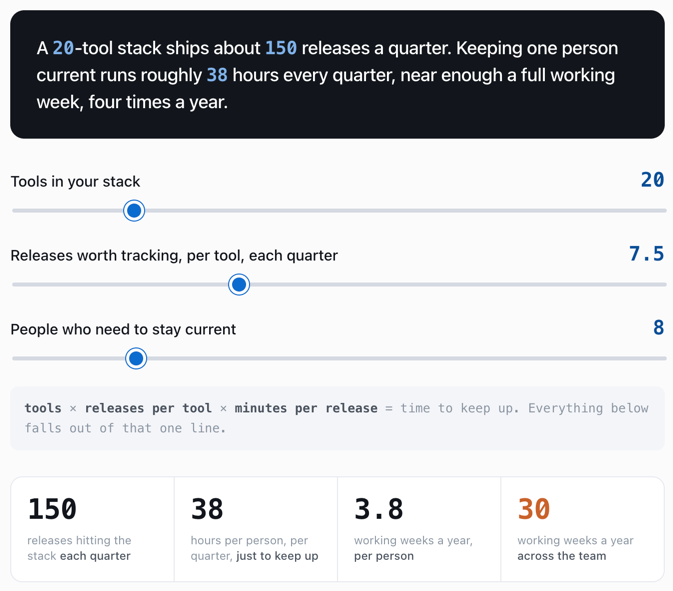
Price the time and it stops being abstract. Twenty tools, a handful of trackable releases each, 15 minutes to read one and decide whether it matters, and you are near 150 releases a quarter and about 38 hours per person just to track them. Across a team of eight, at a normal loaded salary, that is roughly €47,000 a year in salaried attention, before anyone books a single training session.
And most of what you track, you will never use. Pendo studied feature usage across hundreds of products and found around 80% of features are rarely or never touched, while a thin slice of about 12% carries most of the daily work. So the real job is filtering. Learning the tool was never the hard part. The other 80% still has to be read and waved past, and that is the tax nobody budgets for.
The numbers under the curve
I have leaned on Martec's Law before, when I extended it into decay and made the case that stacks rarely fail, they just absorb more effort every year to stand still. What I wanted this time was the data under the curve, because the law usually gets drawn as two clean lines with no numbers on the axes.
 Matthew Niederberger
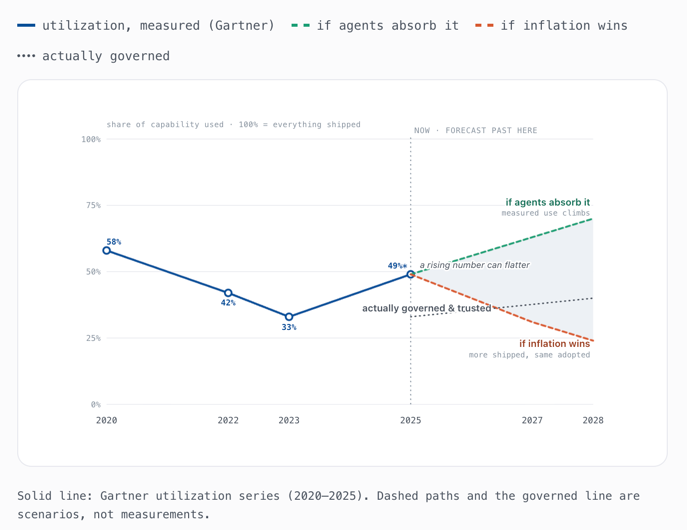
Gartner has asked the same question for years. What share of your stack's capability are you actually using? The answer went from 58% in 2020 to 42% in 2022 to 33% in 2023.
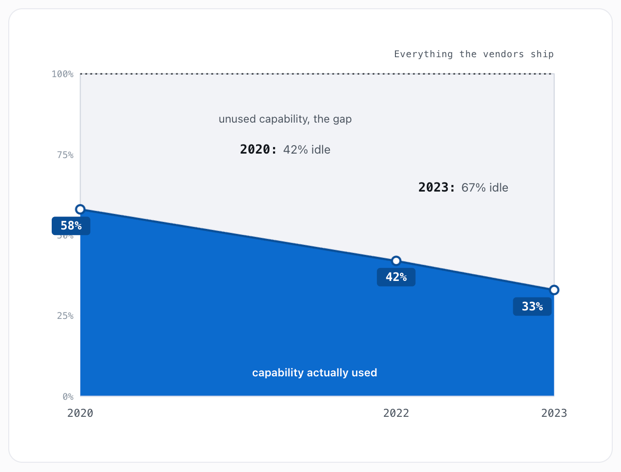
A third in use, two thirds sitting idle, and the idle share growing. Gartner's 2025 reading climbed back toward 49% under a slightly different question, so I would treat the decline as directional rather than gospel. Even at the kinder figure, half your stack is dead weight.
The room is split, and that is the honest place to start
I put the AI question on LinkedIn and watched people who know this field disagree with each other in good faith. That disagreement is the point, so let me hand you the split rather than pretend I have already settled it.
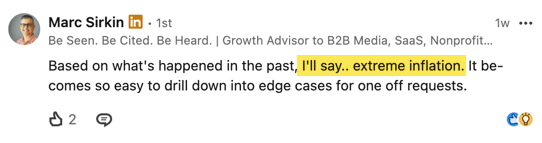
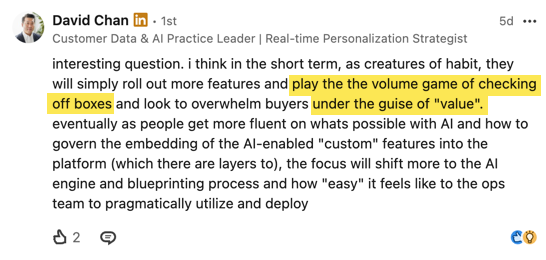
One camp says AI feeds the inflation. Marc Sirkin called it plainly, "extreme inflation," because it becomes so easy to drill into edge cases for one-off requests. David Chan expects vendors, in the short term, to "play the volume game of checking off boxes" and overwhelm buyers "under the guise of value."
Another camp says AI absorbs it. David Raab put the sharpest version of that on the table, and it does something uncomfortable to my own chart, which I will be honest about further down.

And then Daniel Towers, refusing the fork altogether:
Both will be true. Will it matter?
I do not have a clean answer for Daniel. I am not sure anyone does yet, and that is genuinely where this sits.
The fork
Two forces, and they do not act on the same place.
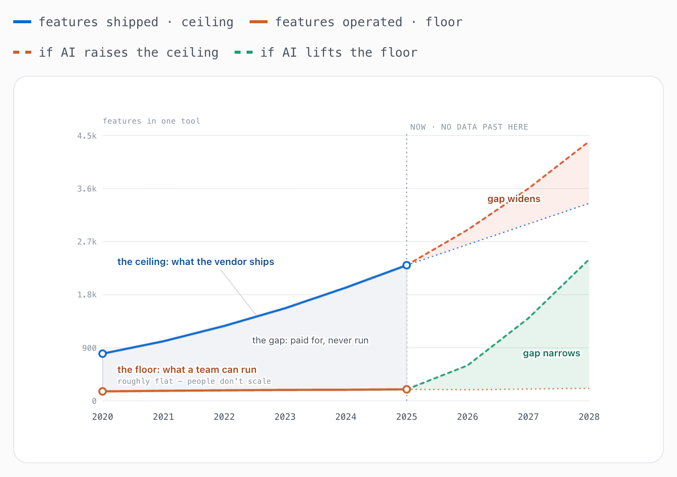
AI raises the ceiling. Features are cheaper to build than they have ever been, so vendors ship more of them, and most of the ones wearing the word agentic are marketing. Gartner reckons that of the thousands of vendors claiming agentic capability, roughly 130 are the real thing. More noise in the firehose.
AI can also lift the floor. Agents can operate features no person ever opened. If an agent sets the send time, you no longer need someone who learned the send-time feature. This is the part that bends Martec's slow curve, because value gets pulled out of the tool without anyone in the organisation having to learn it first. That is AI replacing a process rather than a person, and it changes who you need on the team. David Chan's long game lives here too, the focus moving to how easy it feels for the operations team to deploy rather than how many boxes a vendor checked.
 Matthew Niederberger
Is your team ready to delegate?
The gap is whatever is left between the ceiling and the floor. It can widen. It can narrow. I drew both and did not pick a winner, because the winner is not decided yet.
The catch, and a deeper version of it
This is where it gets less comfortable, in two steps.
Even if AI lifts the floor, a rising utilization number is not the same as value captured. Part of that climb is capability nobody is governing yet. Daniel Towers again, on agentic making a call "with 8% of the data expected," and his reasonable demand that it "should declare that and be clear about what is happening."
I spent enough years in two navies to know what happens when the person on the team was never trained for the task they are assigned. The board looks fine right up until it does not.
That is the first step, the gap moving from unused capability to ungoverned capability. The second step is David Raab's, and it is the one that breaks my chart, or at least the unit my chart counts in.
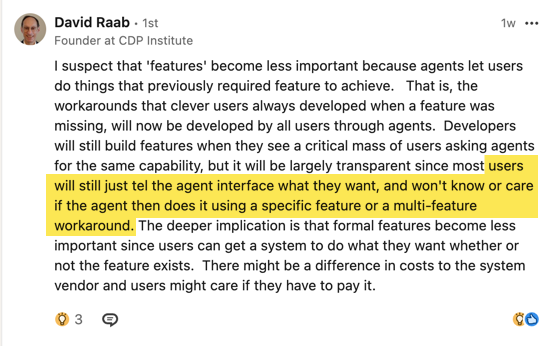
Raab's argument is that features themselves become less important, because agents let people get the outcome whether or not the feature exists.
Users will still just tell the agent interface what they want, and won't know or care if the agent then does it using a specific feature or a multi-feature workaround.
If he is right, then counting features is measuring the wrong thing, and my whole ceiling-and-floor picture is drawn in a unit on its way out.
I am not going to wave that away because it is inconvenient. I think it is a feasible future state, and it is the same arc I have been drawing, one step further along. The gap moves from unused, to ungoverned, to unmeasured, because the thing we counted stops being the thing that matters.
For where we are right now, features are still what vendors ship and price on, so the chart holds. Raab is describing the direction of travel, and I would not bet against him.
It is a capability problem
Notice what actually decides which branch you land on. It is not the AI. It is whether your organisation can deploy and supervise the thing.
That is why the floor has stayed flat. People do not scale with release notes, and the skill to evaluate, adopt, and govern what your stack ships is the same scarce resource whether the features come from humans or agents.
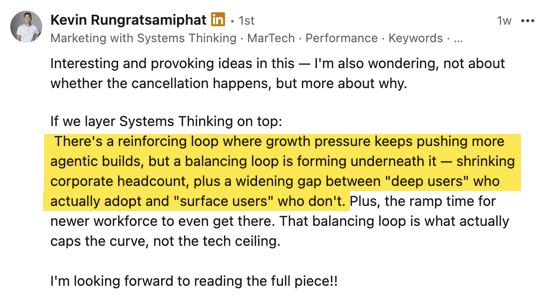
Kevin Rungratsamiphat put a cleaner structure on this than I had. He described a reinforcing loop, growth pressure pushing more agentic builds, running against a balancing loop underneath it: shrinking headcount, a widening distance between the deep users who adopt and the surface users who do not, and the ramp time for newer staff to even get there.
That balancing loop is what actually caps the curve, not the tech ceiling.
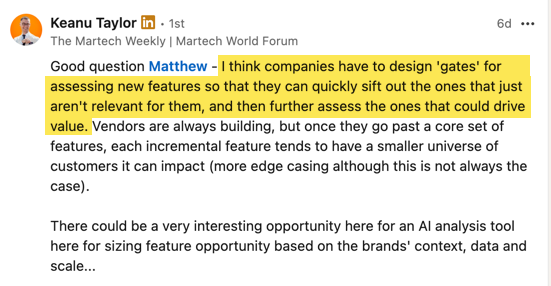
Keanu Taylor gave the practical version, that companies have to design gates for assessing new features, to sift the irrelevant ones fast and then judge which few could drive value. That is a capability, not a tool you can buy. A better platform does not help you keep up with the one you already own.
In my own martech readiness work I split organisational readiness into structure, capability, and process, and this lands squarely on the middle one. AI raises the ceiling on what is possible and raises the bar on the capability you need to supervise it, in the same move.
So, what now?
Let me be straight about what I do not know. I cannot tell you whether AI closes the gap or widens it on net. Governance tooling might mature fast enough to make agent supervision a solved problem, or it might stay a permanent block for us to deal with, and I do not know which way that goes. And if David Raab is right, the feature may not survive as the unit any of us measure. I would be suspicious of anyone who tells you they have this topic settled, especially if it's a vendor.
What I am sure of is smaller and more useful. The capacity to absorb is the lever, whichever way this breaks.
If AI ends up absorbing feature inflation, the organisations that can deploy and govern agents will take the benefit while everyone else watches a healthy-looking dashboard hide a widening problem.
If AI ends up feeding the inflation, that same capacity is what keeps you from going under.
Both branches reward the same work, treating keeping up as a budgeted activity with an owner, instead of something that is supposed to happen for free in the cracks of everyone's week.
The people who replied to my question are working this out in real time, and so am I. That is the actual state of the field right now, and it is a reasonable place to stand, as long as you keep testing what holds and dropping what doesn't.
Your stack isn’t failing.
It’s absorbing more effort than it used to.
The Second Law of Martech scan helps you see where organisational energy is being spent just to keep things working, and where that cost is starting to crowd out real value.
Discussion