

AntiCon lands in London on May 21 and I'm registered for the full main-stage track on day one. Looking at what I've signed up for, the route through the day is revealing... in hindsight. Behavioral science as the human advantage, and as a former data analyst, I am looking forward to this one. The three levers of marketing transformation. Redesigning the marketing organization for an AI era. Architecting the agentic operating model. Co-pilot or autopilot. Are you prepared for the next Martech eras. Conviction at scale.
A bunch of different titles, with vastly different speakers, but the same underlying question asked from seven angles.
What does the marketing function actually look like once agents are doing real work, and who in the buyer's team is responsible for any of it?
That question, along with many others (yes, my head is a busy place) is the one I am seeking answers to. The Martech Readiness Gap piece in March was the first attempt to name it. The comprehension-over-generation argument from a fortnight ago was another angle on the same shape. The piece I wrote after the State of Martech 2026 keynote was the most direct attempt. Scott Brinker and Frans Riemersma described the new ship and named the trust ladder; AntiCon's agenda looks like the first event this year built to walk the next stretch of the conversation, the part about who in the buyer's team actually operates any of this.
AntiCon's agenda is unusual because it's framed around the operating model rather than the platform, which means the speakers have signed up to attempt the harder conversation, and I couldn't be more excited.
Three things I want to be listening for during the day.
One. Does anyone give the trust ladder its progression criteria?
Scott named three rungs in the State of Martech keynote.
Interpret. Create with a human. Autonomous.
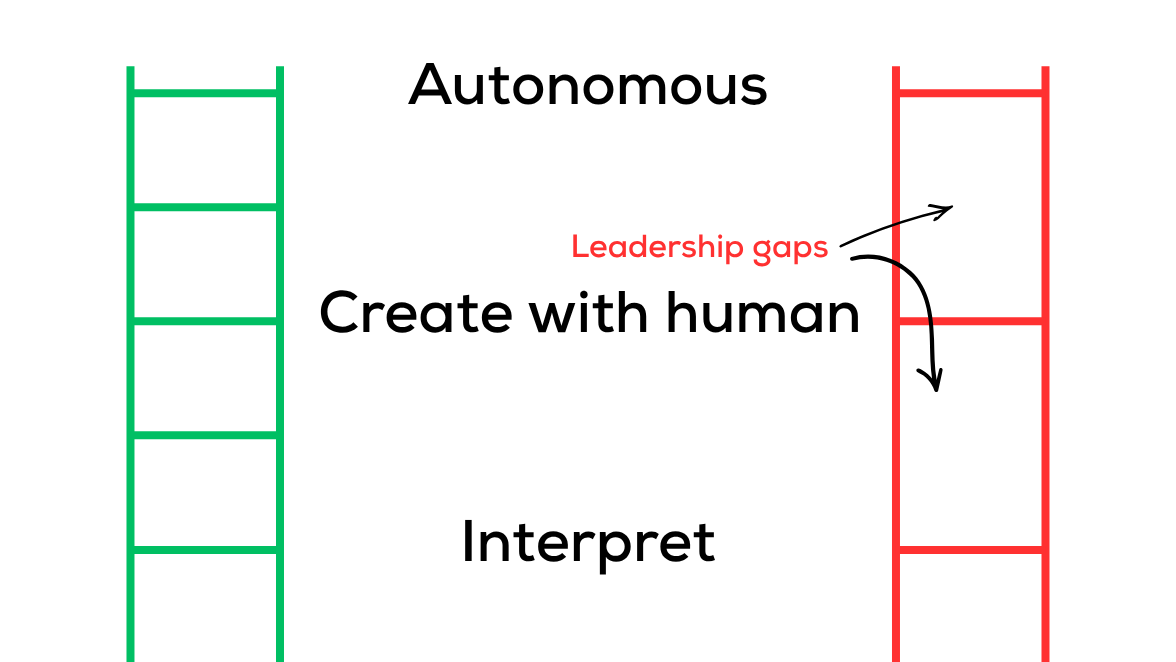
Useful taxonomy, as far as it goes. The next layer, the one I flagged as missing, is what it actually takes to move a use case from rung two to rung three.
Funnel.io's János Moldvay's Co-Pilot or Autopilot session is the most direct heir to this question on the agenda, and Christine Bailey's Conviction at Scale lands at the other end of the spectrum, presumably arguing for getting on with it. Christine being at Moody's matters here because Moody's operates in a category where model risk management is a daily practice. Marketing is just now reaching the point where it needs the same disciplines, and learning from categories that already have them is the fast path forward.
A real answer would name the artefacts.
- Which monitoring signals you'd need clean for thirty days before promoting an agent from human-in-the-loop to autonomous?
- Which decision rights move with the agent, and which stay with a human reviewer?
- What the rollback looks like and how fast it has to fire?
None of that is exotic in regulated industries, and the moment marketing starts borrowing those disciplines on purpose, the trust ladder stops being a feeling and starts being something you can put in a runbook. I'm hoping at least one of these two sessions begins to sketch what those criteria could look like.
 Matthew Niederberger
Two. Is "redesigning the marketing organization" actual design work, or relabelled boxes?
This session belongs to Carlos Doughty, who founded LXA and is hosting the entire event. Putting yourself on stage to talk about the hardest organizational question of the day, on the day you're hosting, is a notable choice. It's the session I'm most curious about and the one where the difficulty is most apparent.
Real organization redesign in an agentic context means working at the level of decision rights. New roles, new reporting lines, new escalation paths, and the actual mechanics of who approves an agent's output before it goes to a customer. The honest test is whether the redesign survives a question like this. If a journey gets misfired by an agent at 2am on a Saturday, who gets paged, what do they have authority to do, and what's the rollback path? Carlos has the chance to show what a serious answer to that question looks like.
Given that LXA exists to teach marketers and to help them figure out what comes next, this is exactly the kind of work the host should be modelling, and it's a good signal for the field that AntiCon has put it on the main stage rather than tucked into a breakout. I'll be listening for whether Carlos has worked the problem at the level of decision rights or at the level of role names. The two look identical on a screen. They diverge the moment something goes wrong, and the answer to that divergence is what I'm hoping to take home from this session.
 Matthew Niederberger
Three. What does Adam Greco do with the era framing?
Hightouch's Adam Greco is presenting Are you prepared for the next Martech Eras, and this is the session I'm most interested in for reasons that have less to do with the topic and more to do with Adam.
I have a low tolerance for era-language at the best of times. It tends to be the marketing version of geological epochs, useful for slides and such, less useful for anyone trying to plan a Q3 budget. But Adam's body of work over the last decade has been precise, technically grounded, and refreshingly free of the hype patterns the rest of the industry has fallen into. So if Adam is the one making the case for thinking in eras, I'm coming in with the assumption that the framing is doing real work.
What I'm hoping for is the talk where Adam names a specific operating-model capability the previous era's marketing function lacked, and a concrete capability the next era's function needs, and is honest about the parts of the previous era that are still load-bearing. Adam at Hightouch is also at an interesting structural vantage point. Reverse ETL and the composable end of the data activation conversation has been at the centre of the last eras-worth of martech stack evolution, and Adam has had a front-row seat to both the rhetoric and the reality.
I'll take notes and come back to this one in the post-event write-up. If anyone is going to make me believe in era-language, it'll probably be him. And whatever I conclude after the session, I'm looking forward to arguing about it with him afterwards.
 Martech Stack Builder
Why this matters beyond AntiCon
The Spring conference circuit's red line is visible from space. The architecture conversation has matured. The organizational design conversation has not. AntiCon's agenda is unusually well-positioned to push the latter forward, because it's been deliberately shaped around the operating model rather than the platform. If the speakers deliver on that framing, the day will be one of the most useful events I've been to this year, and the field will have moved an important step closer to a conversation marketing has been needing for a while.
I'll be there with a notebook and an open ear. If you're attending and want to argue about any of this between sessions, find me. I will have some stickers for you to help alleviate the Martech stress.
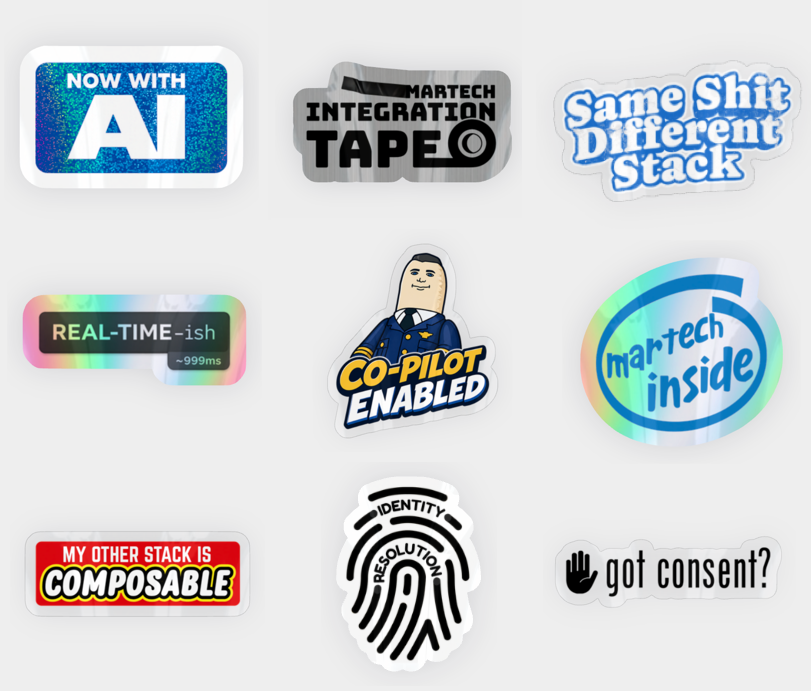
I'm also working on a Martech readiness self-assessment, the worked-out version of the framework I keep referring to in these pieces. Not ready yet, but close enough that I'll be testing language with people at the event.
See you in London.
Do you have any questions after reading this article?
Or need support with your Martech projects?
Discussion