

Last time I argued that the cheapest money in a Martech budget is the capability you're already buying twice, and that the way to find it is to sort your invoices by capability instead of by supplier.
Say you do that. You find one. Now what?
Now the paper decides. And the terms that decide it aren't the ones I went through in the pricing series. Not the meters, not how a vendor counts a profile or an event.
But the dates, and the rights.
I've been handed a lot of Martech contracts over the years, usually late, usually with someone asking whether it's a good deal. Nobody's ever pleased to be in that meeting. Contracts are the vegetables of this job.
And it almost never is the question. The deal is mostly fine. What's rarely fine is whether anybody can do anything about it in the next eleven months.
 Matthew Niederberger
Where the duplicate spend actually comes from ☝️
Thirty days
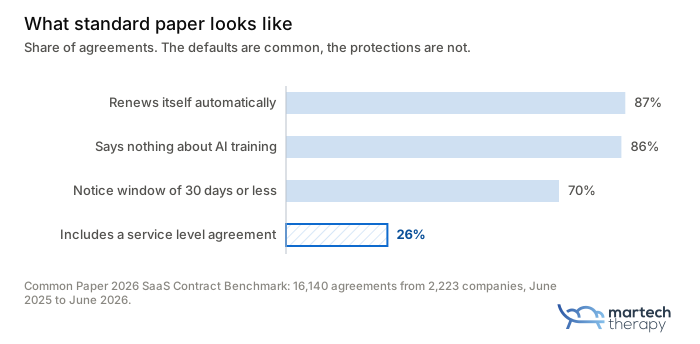
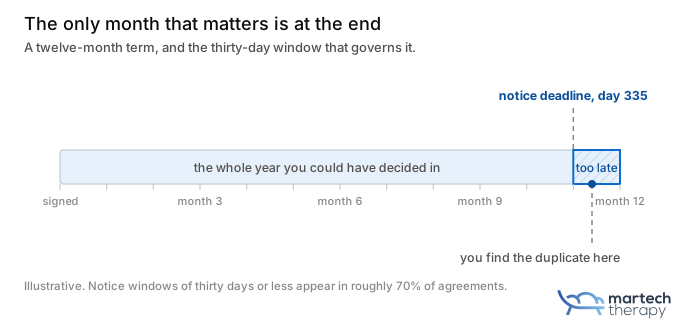
Common Paper went through 16,140 signed agreements from 2,223 companies between June 2025 and June 2026. 87% of them renew themselves. A thirty-day notice window is the standard, turning up in roughly 70%.
So a finding you make in month eleven is one you can't act on until next year. And the one you made in month six sat in a document nobody reopened.
Thirty days isn't a law of nature. Someone chose it, and they chose well. Long enough to look reasonable across a negotiating table, short enough that a marketing team without a renewal calendar will sail straight past it. Whoever drafted that has met a marketing team.
To be fair to the data, Common Paper sells standard-form contracts, so their sample leans toward companies signing on that paper rather than enterprise deals fought over by two legal teams. Take the precision lightly.
My guess is enterprise Martech is worse on notice windows, not better, because the terms are longer and the person who signed has usually moved on. Don't laugh, you know this is true.
Now, if you buy in Europe there's a right here that most people aren't using. The EU Data Act became applicable on 12 September 2025, and it caps the notice period for terminating in order to switch providers at two months, with a transitional period of up to thirty days to complete the move. It applies to contracts you signed before that date as well as after it.
It's a ceiling, not a floor, so a thirty-day window's perfectly fine. What it catches is the other end. If one of your agreements demands ninety days, or six months, that requirement is no longer enforceable as written.
Has anyone checked yours?
Improve, build or enhance
Here's the part I didn't expect to be writing in a piece about contracts.
Most enterprise SaaS terms were drafted before generative AI existed, and most of them grant the vendor a right to use customer data to improve, build or enhance the service.
In 2019 that clause covered bug reports and aggregate usage statistics. Today it functions as a training license, and nobody drafted it as one.
Common Paper again. Clauses that explicitly prohibit a vendor from training on your data have gone from under 1% in 2024, to 11% in 2025, to 14% this year. That's a fast climb. It also means most agreements still say nothing either way.
86% of contracts are silent on whether your customer data trains someone else's model. Silence is not a no.
TermScout's contract data, published through Stanford Law's CodeX, found that 92% of AI vendor contracts claim data usage rights beyond what delivering the service requires, against a market average of 63%. The same analysis found only 33% offering indemnification for third-party IP claims, and only 17% committing explicitly to comply with applicable laws, against 36% across SaaS generally.
Unfortunately, none of this is hypothetical.
Figma was sued last November, a proposed class action in the Northern District of California, alleging it trained on millions of customer design files without explicit consent. The claim was framed as breach of contract and trade secret misappropriation rather than copyright, because the argument is that the marketing promised privacy and the terms did not.
Figma disputes all of it, and says training happens only with explicit authorization, on de-identified data, aimed at general patterns rather than customer content.
And in May a judge sent the whole thing to arbitration, on the grounds that the plaintiff had accepted Figma's terms of service, and those terms contain an arbitration clause.
Speechless.
In any case, the paper decided that too. A dispute about what the contract permitted, resolved by a different part of the same contract, before anyone got to the merits. Whatever else you think of that outcome, it's a fairly emphatic argument for knowing what you signed.
Adobe got there eighteen months earlier and went the other way. Enough customers objected to a terms update in June 2024 that Adobe publicly committed not to train generative AI on customer content.
Why does this land harder in Martech than in a design tool?
Because a CDP or a CEP holds behavioral data about identified people, and that changes what the clause is actually licensing.
Think about what you told those people.
Your consent notice explains why you collect the data and what you use it for. Improving a vendor's model is not on that list. It wasn't on the list when the notice was written, because the notice predates the capability, and nobody has gone back to ask. So you can end up with a lawful basis for processing that covers your use of the data and says nothing about theirs.
I don't think most vendors are doing this.
I think most of them have a clause that permits it, which is a different problem, and a much easier one to fix at renewal than after a complaint. Nobody's being sinister. They're just holding a permission they never asked for and have not thought about.
Getting out
Two questions nobody asks at signature.
- What happens if this doesn't work?
- What do I take with me when I leave?
On the first, the benchmark is pretty bleak. Service level agreements appear in 26% of agreements, down from 29% in 2024. Roughly three in four contracts promise nothing measurable about uptime at all, which is a confident position for an industry that sells reliability on every slide.
On the second, the Data Act is doing more work than most Martech buyers realize. Until 12 January 2027 a provider may charge for switching, but only for costs it directly incurs. After that date switching charges go to zero. Data comes back in a structured, commonly used, machine-readable format. Early termination penalties survive all of this, so it isn't a free exit, but the cost of the exit itself's on a clock.
That's worth knowing at signature rather than at renewal.
A three-year term signed this year runs straight through that date, so the switching costs quoted in it are describing a world that expires halfway through the agreement.
If you're negotiating a multi-year deal in Europe right now, make sure to keep this in mind.
Whose job this is
Marketing signs the deal and negotiates the meters such as usage and seats, because the meters are what the budget conversation is about.
Legal reviews for corporate risk, liability and indemnity and data protection. Whether a thirty-day window is operable by a team that has never kept a renewal calendar is an operational question wearing legal clothing. So nobody asks legal, and nobody asks anyone else either.
Procurement holds the dates, in a system marketing has no particular reason to open.
Silos, all over again.
There's evidence that owning this oversight pays.
The Martech Weekly found 62.2% of enterprise organizations now manage renewals proactively, and among those, 70.9% can show a clear measurable contribution from Martech, against 41.7% of everyone else.
Keeping a renewal calendar isn't administrative hygiene. It tracks with being able to defend your budget, which is presumably why the proactive ones bother. Though I can't tell you which way that runs. Maybe the calendar makes you defensible, or maybe the teams organized enough to keep one were always the teams who could show their numbers. Either way it's the same amount of work.
Same shape as the duplication problem.
Nobody did anything wrong, and the result is still bad.
Three questions
Luckily, you don't need a legal review to fix most of this. You need three answers per contract in your stack.
- When does it renew, and by when do I have to say otherwise?
- What may they do with the data I put in, including whether any of it trains anything?
- What comes back to me on the way out, in what format, and who pays for the move?
Then put the answers somewhere sorted by date rather than by supplier.
That list is the entire difference between a duplication finding you can act on and one you file until next year.
Honestly, the sorting is the whole trick, and it's the same trick as last time. Your contract register is organized around who you pay. Almost nothing you need at renewal is.
If you'd rather not do it by hand, contract and SLA management went into open beta on Martech Stack Builder. That one's mine, so take the rest of this paragraph with that in view.
It does the join this article keeps circling.
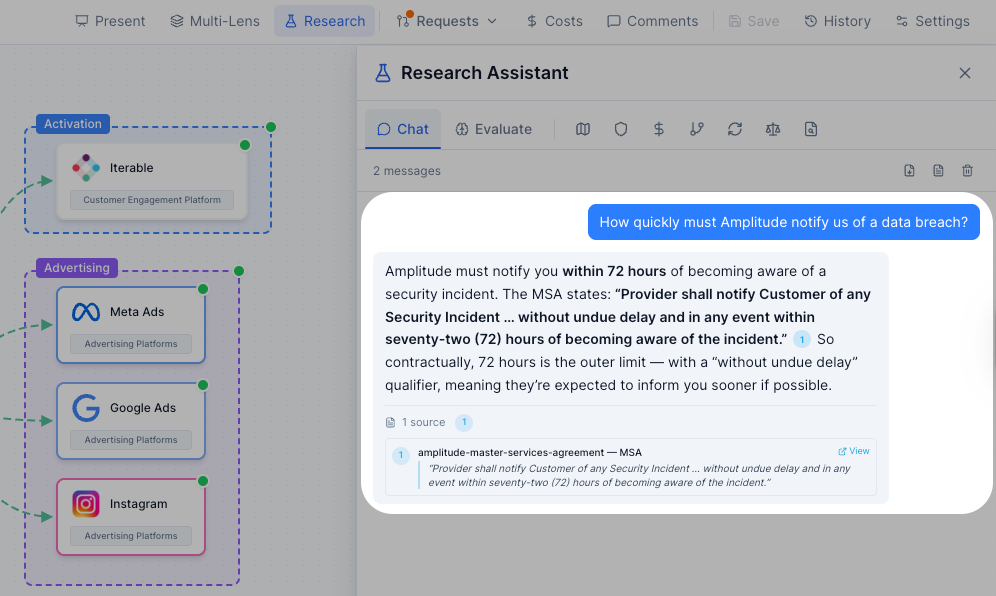
Upload the MSAs, the SLAs, the DPAs, and they get evaluated against your actual stack diagram, against the tools and the connections and the metadata already sitting on the canvas.
A clause ends up next to the system it governs instead of in a folder someone opens once a year. Ask in plain language, get the answer back with the clause cited.
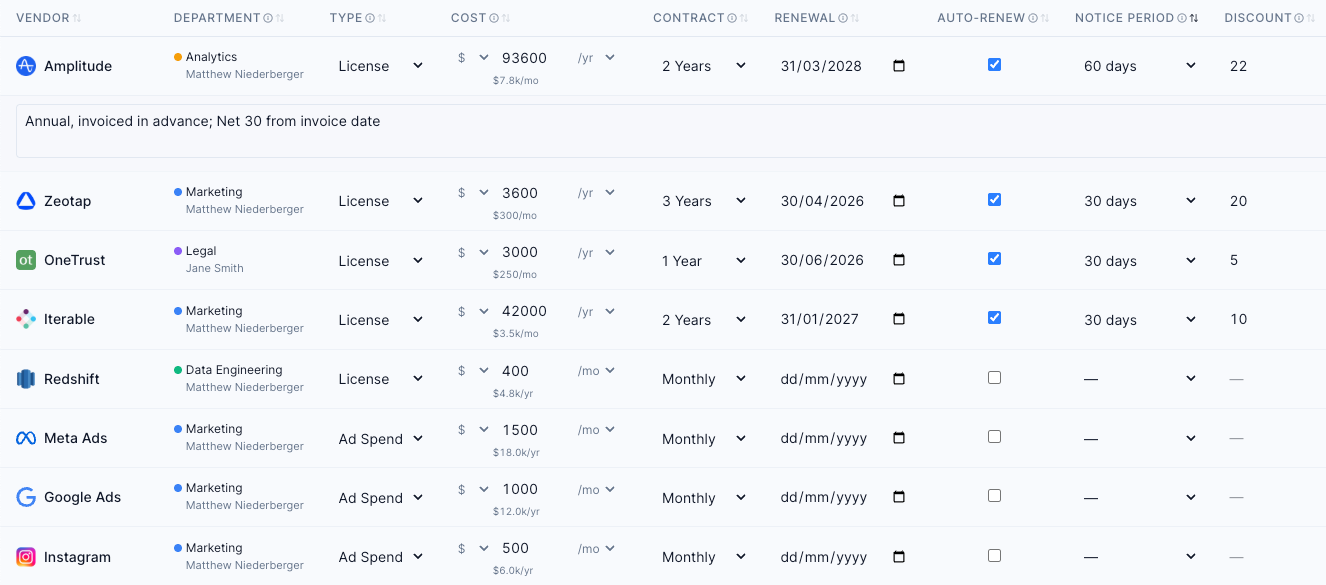
It pulls the commercial terms onto the diagram too, so the cost data stops living in finance and starts living next to the architecture. Which is the capability-sorted list from last time, except you don't have to type it out yourself.
And, you get on-time notifications when a renewal is looming, in-app, through email, in Slack, or even via webhook.
What the meters cannot tell you
The pricing series answered what you're paying and how the meter runs. These are the terms that decide whether any of that is information you can use.
87% renew themselves. Most say nothing about AI training. Three in four promise nothing measurable about uptime.
None of that is a scandal. It's what standard paper looks like when nobody on your side is checking it for the dates.

Start building your Martech Stack designs today 👇🏻
Discussion