


In part 1 I showed you a scorecard.
It was the five-point "litmus test" on cdp.com, the page that ranks first when you search for an agentic CDP, written by Treasure AI's CEO, and it scored Treasure AI five out of five and its rivals one and two.
 Matthew Niederberger
Where that scorecard came from ☝️
That test is not useless. It just answers the wrong question. It measures how agentic a platform is, in the abstract, and then treats the most-agentic score as the best buy.
That is like ranking cars by horsepower and telling a family of five to buy the drag racer. Powerful, yes. Practical, not so much.
The question you actually have to answer in the room is not the one the test answers. It is which tool fits what you need, and what you are ready to run. That is rarely the most agentic one.
First, remember what the thing is for
Before any scorecard, one grounding point, and I am borrowing it from Tony Byrne at Real Story Group, who put it more plainly than most.
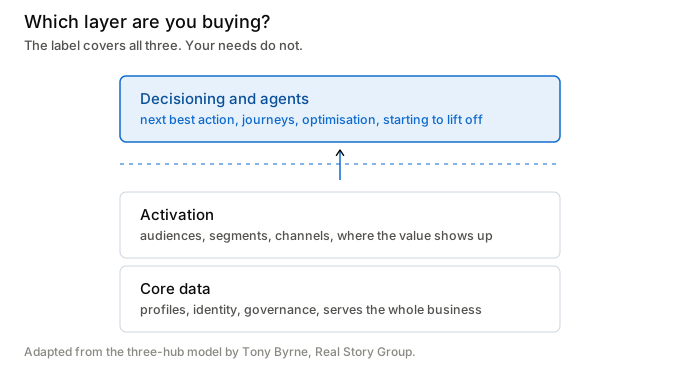
A CDP earns its keep at activation. Unifying data is necessary, but the value shows up when a marketer can build an audience, act on it, and see what happened.
Byrne's list of what marketers actually want, a friendly view of their own data, simple segments, real activation, and a fast lane for the moments that need it, is a better starting point than any vendor's capability grid.
 Tony Byrne
Tony Byrne's value-first take, worth your time ☝️
It is the same instinct behind the four ownership questions I gave marketers in Composable CDP, translated for marketers. Start from what you are responsible for, not from the architecture diagram.
Tony Byrne makes one more point that matters for the whole series.
The agentic, decisioning part is starting to separate out of the CDP into its own layer.
This is something I eluded to at the end of part 1.
So when a vendor sells you an "agentic CDP", ask which layer you are actually buying: the data, the activation, the decisioning, or a bundle of all three.
The trap the vendor scorecards set
Every vendor litmus test has the same tell. The criteria are the things that vendor happens to be good at.
Treasure AI's rewards native messaging and a closed loop inside one platform, which is how Treasure AI is built. Run the same exercise on a warehouse-native vendor, or on the data cloud, and you get a different test with a different winner every time.
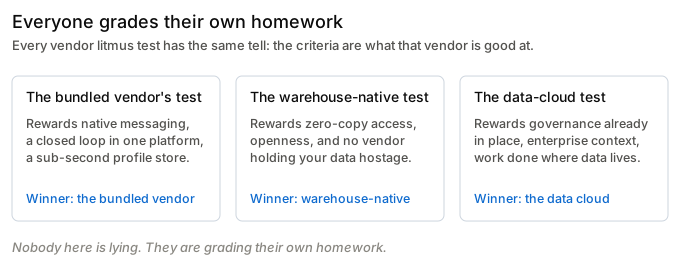
The tool that scores highest on raw capability is rarely the one that scores highest for you.
The fix is not a better absolute test. It is to score fit. Rate what you need first, then score each tool against that need, not against an ideal nobody asked you about.
How to score an agentic CDP for fit, not purity
Here is the version I would take into an agentic CDP evaluation. Six dimensions. For each one, rate your own need first, must-have, useful, or not needed, and only then score each shortlisted tool from zero to three.
Decisioning speed, against your use case. Do you need real-time, in-session decisions, or is a daily or hourly refresh fine?
Warehouse-native tools are largely slow at sub-second today, packaged and hybrid tools are faster. Most marketers need less real-time than they think, and it is exactly where they overpay 😉.
 Matthew Niederberger
Read about "right-time" marketing in my most recent post ☝️
Channel reach, against where you actually run. Can it act across the channels you use, natively or through solid activation partners?
Score the gaps that hit your real channel mix, not a maximal one.
The autonomy line, and whether you can move it. What does the agent decide alone, and what does it bring back for sign-off? Can you set that gate to the level of delegation you are ready for?
A tool that only suggests is an autocomplete. A tool with no gate is a liability.
Visibility, control, and brand. Can you see why the agent did what it did, constrain it, roll it back, and encode your brand lines, frequency caps, and suppression so they hold at scale?
Score low here and nothing else rescues the tool, because you cannot be accountable for what you cannot inspect. This is also where the old question of who is actually in charge comes home.
Where the data actually lives. Your warehouse, the vendor's store, or a copy of both?
This decides ownership, portability, and how locked in you are. It is the mirror of the speed question, and the place warehouse-native tools tend to win where packaged ones do not.
Goal and measurement fit. Can it take the goals and the clean signal you can actually provide, and report against them?
An agent with no goal to chase is an expensive draft generator, which is the whole of part 4.
Add them up and you do not get a winner. You get a fit profile: where a tool is strong on the things you need, and where it is weak on things you do not.
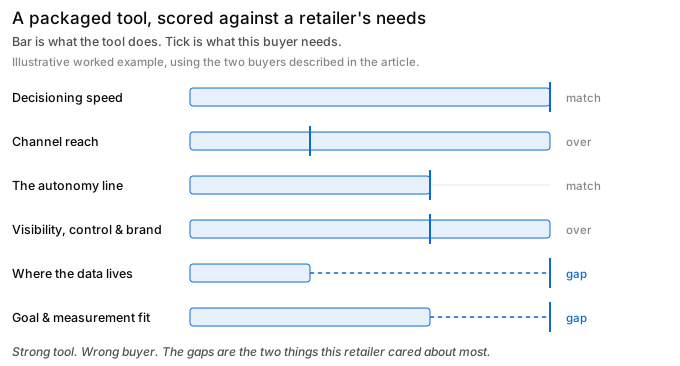
The same scorecard, two different winners
This is the part a vendor scorecard can never show you, because that kind of test has one winner built in from the start. Run the fit version and the winner changes with the buyer.
Take a large retailer with a mature warehouse and real-time, on-site personalization at the core of the business. Speed is a must-have. Owning the data is a must-have. Native messaging matters less, because the team already runs its own channels. A data-cloud-native or hybrid platform, a Databricks-style build, scores well here.
As Mike Pastore pointed out, that is exactly who Databricks sells to: the CIO and the data team at a large enterprise with the maturity to run it.
 Mike Pastore
Mike Pastore on who each model actually fits ☝️
Now take a mid-market B2B team running weekly lifecycle campaigns with a lean data function. Sub-second decisioning is not needed. What they need is a friendly builder, native messaging, and a tool that works without a warehouse they would have to trust first. A packaged platform with its own data layer wins this one comfortably, and the warehouse-native tool that topped the first scenario would be a slow, heavy mismatch here.
Same scorecard, run twice, and the winner flips.
Mike Pastore landed on it from the vendor side too:
It is unlikely either approach wins. Each approach can be a winner for the right customer.
That last sentence is the whole reason to score fit instead of purity.
Why this is a structure question
Notice what decided both scenarios. Not the agent. The organization around it.
Whether real-time matters, whether you own the data, whether you have the channels and the team to run any of it, that is Structure, the second of the three readiness dimensions this series runs on. The scorecard is really a mirror. It tells you as much about your own readiness as it does about any vendor.
So before the demos, fill in the need column for yourself. If you cannot, that is the first thing to fix, and it is far better to find out now than two quarters into a migration.
I will fold these six dimensions into a one-page checklist you can carry into the room, and into the readiness check in part 5.
Next week, part 4: measurement, the dimension the whole category is leaning on, and the one most teams answer worst.
Do you have any questions after reading this article?
Or need support with your Martech projects?
Discussion