


A bank buying a customer data platform has somebody, somewhere in the building, whose job is to check whether the company selling it can afford to still be there in three years.
A retailer buying the same platform on the same three-year term usually has no one doing that at all.
Same product, same paper, same length of commitment.
The difference is which industry you happen to work in, and whether anyone thought to open a document that's been sitting in public the whole time.
Does anybody actually do this?
In one corner of the market, yes, and it is now the law.
Since January 2025, European banks, insurers and investment firms have been living under a rule called DORA, short for the Digital Operational Resilience Act. Before they sign with a technology supplier, they have to do proper homework on it. Where that supplier is going to run something the firm treats as critical, the rules sitting underneath DORA say that homework has to cover whether the supplier has adequate financial, human and technical resources.
In plainer words:
Can this company afford to keep showing up?
Everywhere else, that check either doesn't happen or it happens somewhere in procurement and never reaches the person who actually has to live with the tool. I've sat through selections where we compared support response times to the minute and nobody asked a single question about the company behind the product.
One honest limit before we go further 👇
Everything below comes from filings, which only listed companies have to produce, and most of Martech is privately held. If your vendor is private you can't do any of this. What you can do is ask the questions out loud in the deal, note when they last raised money, and treat a refusal to answer as its own kind of answer.
The most useful page has nothing to do with money
Start somewhere easier than the accounts.
Start with the calendar.
Every one of these companies tells you exactly when its financial year ends, and they don't all end in December. Of the fifteen I checked, six don't. Braze, Sprinklr, Salesforce, Snowflake and Yext all close their year on 31 January, which means their big final quarter runs from November through to the end of January, and their other quarters finish on 30 April, 31 July and 31 October.
Adobe is on its own timetable entirely, which I personally find funny, closing on the Friday nearest to 30 November, with quarters that end in late February, late May and late August and never land on a month end.
So the received wisdom that December is when everybody gets desperate is right about nine of these companies and wrong about six of them, including some of the biggest names you will ever sit across from. Use it to your advantage 😉
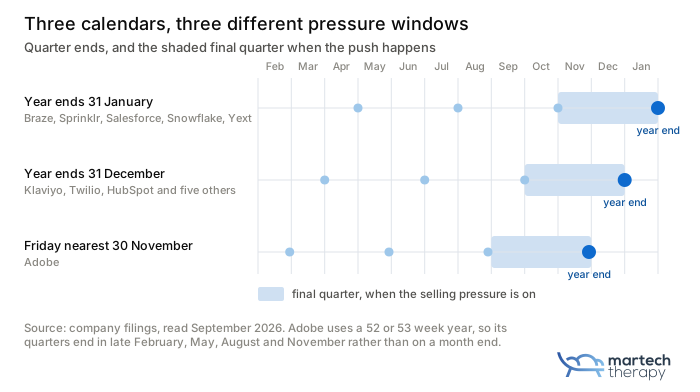
I keep the full list, with every quarter end date on its own page and re-check it every quarter, because it is more useful as a lookup than as a paragraph.
Sprinklr writes the consequence down in its own annual report, in a sentence I'd print out and keep:
A large percentage of our customers make their purchases in the fourth quarter of a given fiscal year and pay us in the first quarter of the subsequent year.
That's a vendor, in an audited document, confirming the thing every salesperson denies in the room.
Your renewal date is probably not an accident
Here's the part I'd do first, before any of the rest of it.
Go and look at when your current contract expires. Actually do it.
Then look at where that date falls in your vendor's year. If your renewal happens to land inside their final quarter, that was very unlikely to be luck. Renewal dates get set when you sign, and the person setting them knew their own calendar while you were thinking about implementation timelines.
It works in both directions, which is why it's useful.
If you are buying now, the end date of the contract is negotiable in exactly the same way the price is, and almost nobody treats it that way. If you already signed, at least you now know which side of the table the clock is on.
Three things to keep in mind before anyone gets excited about squeezing a discount out of the last week of January.
A discount taken at quarter end is nearly always paid for somewhere else in the paperwork. Trust me on this. It comes back as a longer term, as an automatic renewal, or as a price that steps up in year two. That is the same problem I wrote about in the dates and the rights, and it's why the discount and the contract have to be judged separately.
Pushing to the actual final day is also how legal review gets skipped, and skipped legal review is how the clauses you hate end up in the document.
And the pressure is real in the final quarter and much weaker in the other three. This is one lever, not a season ticket.
Two dollars spent selling for every dollar spent building
Now the accounts, and only one line of them.
Every company splits out what it spends on sales and marketing, and what it spends on research and development, meaning the people who build the product. The gap isn't subtle.
For every dollar Braze took in last year, about 44 cents went to selling and about 23 cents to building. Klaviyo, 41 cents against 24. Amplitude, 55 cents against 28, and its total costs came to slightly more than everything it earned. Sprinklr is the widest at 34 cents against 11, three dollars on winning the next customer for every dollar on the product the current ones already bought.
Check out the chart below for a better understanding.
A nice find is that Twilio is the other way round. 17 cents selling against 20 building, which is a useful reminder that infrastructure companies sell differently from application companies.
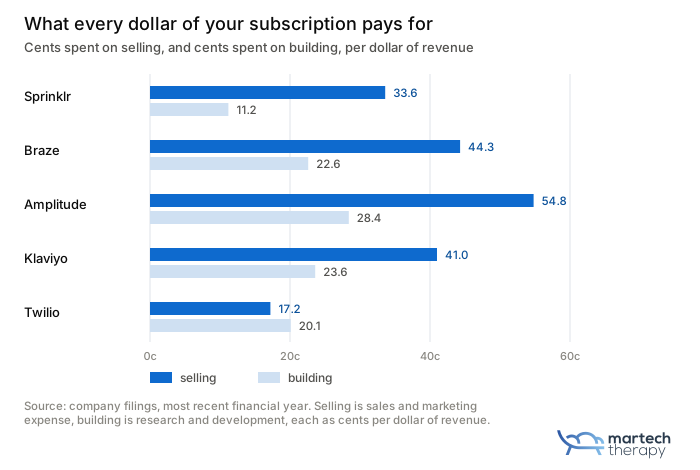
What that tells you as a customer isn't that anyone is doing something wrong. It tells you where your feature request sits in the queue. When the company spends twice as much finding the next customer as it does improving the product, the thing you asked for last spring is competing with next quarter's new logos, and it's losing.
The question that comes out of this is a good one to ask in a renewal:
What shipped in the last twelve months that we actually use?
 Matthew Niederberger

The retention number you cannot compare
One more, quickly, because it gets waved at you constantly.
Vendors love quoting retention, which is roughly how much last year's customers are spending this year. Anything above 100% means the base is growing without new customers.
It sounds like a clean comparison between two suppliers.
It isn't, and they say so themselves.
Sprinklr's version leaves out professional services entirely. Twilio's includes usage. Braze's counts certain professional services inside the underlying figure. Braze's own filing warns that its metric "may not be comparable" to anyone else's, and Amplitude states in writing that it is "not aware of any uniform standards" for working these out.
So when two vendors put their retention figures side by side in your evaluation, you're looking at a comparison both of them have formally disclaimed. Ask how they calculate it. The reaction to that question is usually more informative than the figure.
Twenty minutes, four things
None of this needs a finance background (I sure don't have one 😉), and you're not valuing anybody.
Search for the company name on the SEC's EDGAR platform, which is the free public database where American listed companies file. Open the most recent annual report, called a 10-K. Then look at four things and write them down.
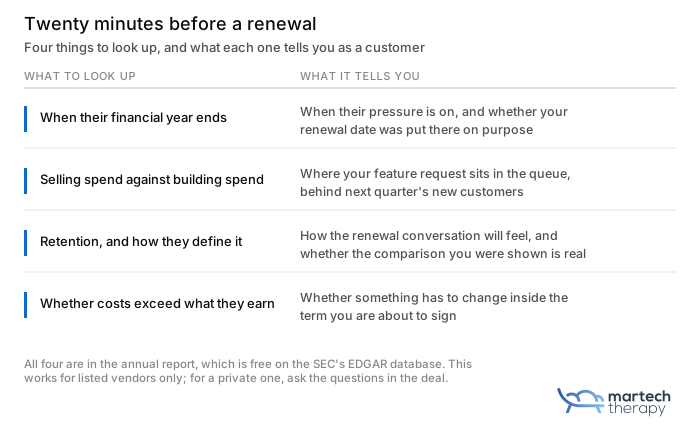
Two small things you will run into, as examples:
- Semrush stopped being a listed company in May 2026, so its disclosure simply stops, which is a real thing that can happen to a supplier you depend on.
- Databricks has no annual report at all, because it is private, which is the clearest demonstration of where this method stops.
One trap worth knowing. The January companies name their year after the calendar year it ends in, so Salesforce's "fiscal 2026" is mostly what the rest of us called 2025. Line that up against a December company's 2026 and you're comparing two periods that barely touch.
What this does not do
To end, let me be honest with you.
It won't tell you whether a vendor is about to fall over. It won't tell you whether the product is any good, which still matters more than any of this. And it isn't investment advice, because none of this is about whether these are good companies to own.
It's about what happens to you as their customer.
What it changes is the conversation. You walk in knowing where you sit in their calendar, roughly where your request sits in their priorities, and which of their numbers you are allowed to take seriously.
And if your vendor is private, which most of them are, the whole method collapses into one question you can ask in the next call.
When does your financial year end?
They will tell you. It was never a secret.
It just suited everybody that you never asked.

Start tracking your Martech contracts, and never miss an opportunity to renew on your terms.
Discussion